Which Bangalore market should you go to?
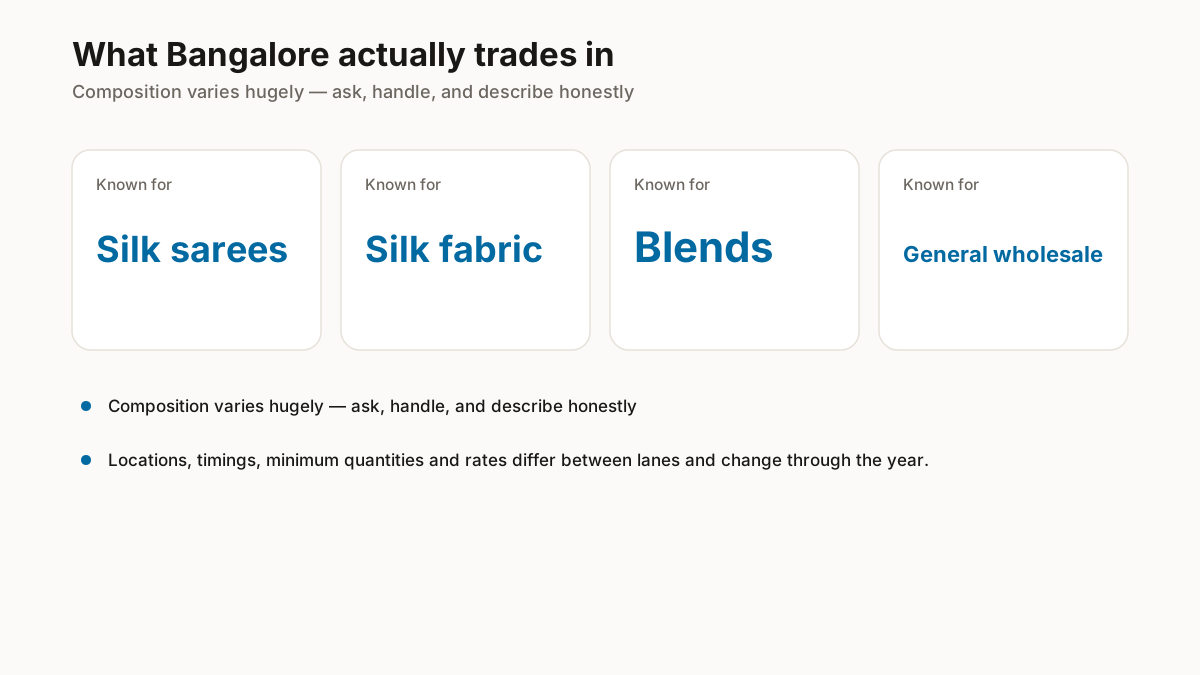
Bangalore's wholesale trade centres on Chickpet, and the city is strongly associated with silk — a category where what you are buying is far harder to judge than in cotton.
Chickpet itself is dense and old, with lanes that specialise, so the useful preparation is knowing which part handles your goods before you arrive rather than walking the whole of it.
Silk is the reason to come and the reason to be careful. It covers everything from pure mulberry through blends to fabrics that are silk in name only, and the differences are not obvious to somebody who has not handled them side by side.
Where do you sell? That decides what you buy
Silk is a considered purchase, which changes the channel maths. A buyer spending more reads the description, looks at several photographs and asks questions — behaviour that suits Instagram and WhatsApp far better than a price-sorted marketplace grid.
Meesho works for the lower end of the range, where the buyer is comparing and the price does the talking.
The higher the price, the more the sale depends on trust, and trust is what an audience gives you and a search result does not.
| Meesho | |||
|---|---|---|---|
| Buyer arrives | Searching and comparing on price | Discovering while scrolling | Already knows and trusts you |
| Marketplace commission | Yes — set by category | None | None |
| Return rate | Highest of the three | Middle | Lowest — she knows you |
| Listing rules | Strict QC, primary image must be clean | None | None |
| What sells | Everyday basics at sharp prices | Distinctive, photogenic, occasion wear | Mid to premium, and repeat orders |
| What it needs from you | Volume and price discipline | A look and consistent posting | An audience you already built |
Commission rates differ by category and change — read yours from the channel’s own rate card, and run it through the break-even calculator.
How do you get there and get around?
Chickpet is reachable by metro and the surrounding lanes are walkable, which makes Bangalore one of the easier hubs to navigate on a first visit. Driving into the area is not practical.
Go on a weekday morning. The lanes get crowded later and a dealer with time is worth more to a new buyer than one who is busy.
First time? Take someone, keep cash split, and give yourself 4 hours minimum. Silk in particular rewards handling several pieces before buying any, and that takes longer than people plan for.
Transport onward is straightforward and most dealers arrange it. Ask before the price is settled, and photograph whatever docket you are given.
What happens on a first buying trip?
Small lots are normal in Chickpet. The area trades heavily with small retailers, so a reseller taking a dozen sarees is a familiar customer. This is not a market where you need volume to be taken seriously.
Compare 3 dealers before buying, and on silk compare by handling rather than by price. Two pieces at the same rate can be different fabrics entirely, and the only way to learn the difference is to hold them in the same afternoon.
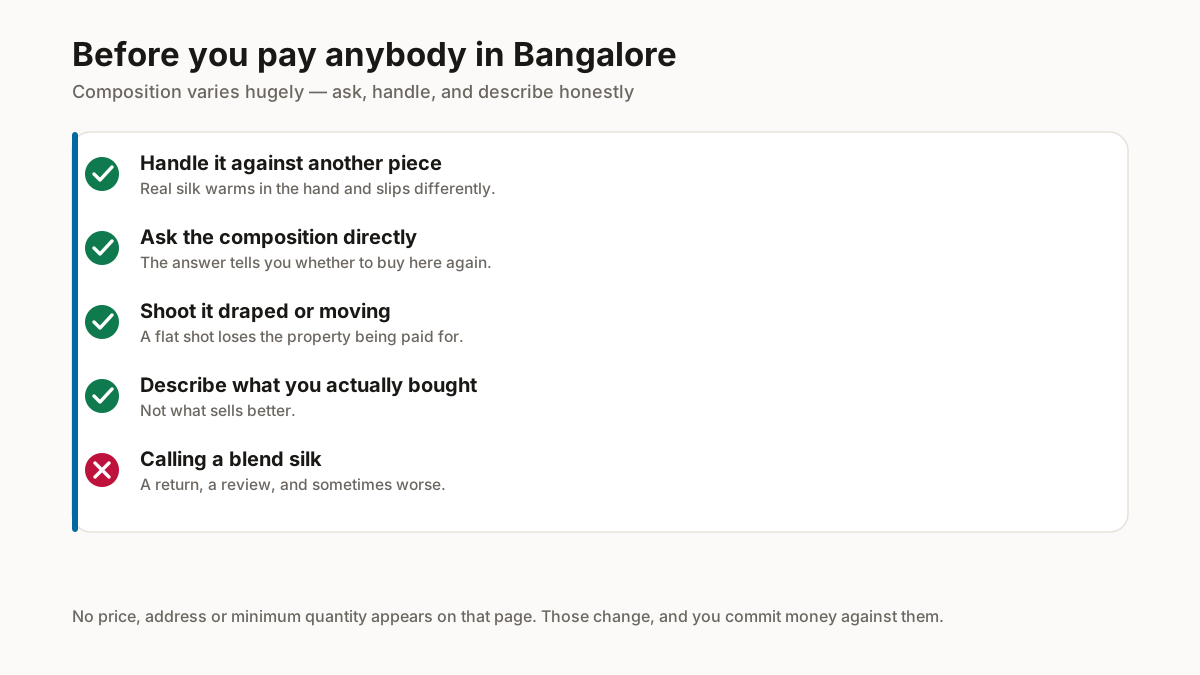
Ask the composition directly and listen to how the answer comes. A dealer who tells you plainly that a piece is a blend is a dealer worth returning to; one who is vague has told you what you needed to know.
Ask what happens with a faulty piece before you pay, not after.
How much do you actually have to buy?
Tiers here are gentler than in a production town because Chickpet is a trading area. Single pieces, half dozens and dozens are all normal transactions, and the rate improves steadily rather than in steps.
On silk specifically, buy narrow first. Higher-value stock ties up more money per piece, so 6 pieces across 3 designs teaches you what sells at far less risk than 18 of one.
Who should you actually go and see?
Chickpet's lanes specialise, and the dealers who handle genuine silk are not always the ones with the largest frontage. That distinction is invisible from outside.
The dealers worth knowing are the ones other small sellers name, and that list is not published anywhere.
Bangalore supplier list
We are building a list of Chickpet dealers by what they genuinely stock, because frontage size tells you nothing about who handles real silk. Every number on it comes from a supplier who asked to be listed.
Your number is used to send the list and nothing else.
What should you check before paying?
Wholesale generally has no returns, so once you have paid a bad piece is yours. With silk the risk is not only a faulty piece but a piece that is not what you were told, which makes composition the first check rather than the last.
The hand, against another piece
Real silk warms in the hand and has a slip most synthetics do not replicate. Holding 2 pieces at once teaches you more in 1 minute than reading about it does.
How it takes light
Silk shifts colour subtly as it moves. A fabric that looks flat under a tube light and stays flat when you turn it is telling you something about what it is.
The composition, asked plainly
Ask what it is, and write the answer down. Describing a blend as pure silk in a listing is a return, a poor review and on a marketplace sometimes worse.
The blouse piece and the length
Confirm both. They are the 2 most common sources of dispute on a saree listing and both are answered by looking before you pay.
Take this checklist with you
Everything above is easy to remember at home and easy to forget in a crowded lane. Same list, printable, to carry in a bag.
Buying trip checklist — Bangalore
Print this and carry it. Tick as you go.
Before you leave
- ☐Confirmed the market is open today (call, do not assume)
- ☐Decided which market — they trade different goods
- ☐Cash split across two places, not one pocket
- ☐Notebook or phone notes ready — six suppliers blur into one
- ☐Someone with me, if this is the first trip
- ☐Plan for getting goods home before buying them
Which market for what
- ☐Chickpet — the main wholesale trading area
- ☐Silk dealers — sarees and silk fabric
- ☐General wholesale lanes — mixed apparel
Ask at every shop
- ☐What is the rate at the quantity I can actually take?
- ☐Will this design be available again next month?
- ☐What happens if a piece arrives defective?
- ☐What is the smallest lot you will sell me?
Check before paying
- ☐An inside seam — loose threads, skipped stitches, puckering
- ☐Colour across 3 or 4 pieces, in daylight not tube light
- ☐Which sizes are actually in the lot, counted not stated
- ☐Compared the rate against 2 other shops in the same lane
Wholesale generally has no returns. The checks above are the only protection you get.
What margin will this stock leave you?
Higher-value stock changes the shape of the risk. A single unsold silk saree ties up what several cotton pieces would, so the margin has to be modelled on what actually sells rather than on what you hoped would.
Same garment, three channels
Put your own numbers in. Nothing here is assumed — commission is set by category and changes, so read yours from the channel’s rate card. The return rates are starting points to overwrite with your own.
Return rate on each channel
Ad spend per order
Meesho
₹178
per order after returns · 25% margin
₹276 on a delivered order
commission + returns + ads
₹256
per order after returns · 37% margin
₹306 on a delivered order
no commission, ads to be found
WhatsAppMOST LEFT
₹300
per order after returns · 43% margin
₹321 on a delivered order
no commission, lowest returns
On these numbers the same piece leaves ₹123 more per order on WhatsApp than on the weakest channel — which is the argument for choosing the channel before choosing the stock. For the full picture including GST and a target margin, use the break-even calculator.
Why does listing the stock take longer than buying it?
Silk is the hardest fabric on this list to photograph, because the property you are selling only appears in movement.
Shoot draped rather than flat, in diffused daylight. Direct sun blows the highlights white and a single indoor bulb flattens the fabric entirely; neither shows what is in your hand.
Budget 4 images a piece and expect to reshoot some. On 20 sarees that is 80 images before any of them is sized for a portal.
Then write the description properly, because a considered buyer reads it. Composition, length in inches, and care instructions are what convert here.
You have the stock. Now the listing.
After the trip
20 silk sarees at 4 photographs each is 80 images to prepare
Silk needs more images than most categories because the fabric only reads in movement. Preparing 80 by hand is the fortnight; StitchMagic sizes and renames the whole set in one run.
- Repairs and sharpens the photo
- Exports the 4 marketplace sizes from one upload
- Keeps the primary image clean, so QC does not bounce it
- Renames every file to its SKU
- Builds the WhatsApp PDF catalogue
Is it actually free?
Single photos are free. No signup, no watermark, no daily limit.
Do my photos get uploaded?
No. It runs in your browser — the files never leave your phone.
Is it a subscription?
No. The bulk pack is a one-off ₹99, and one photo counts once.
Runs in the browser, so an unreleased range never leaves your phone.
Where does Bangalore stock get listed?
Silk sells across Meesho, Flipkart and Amazon, and better on Instagram and WhatsApp at the higher price points where trust matters more than search ranking.
Wherever it goes, state the composition in the listing rather than in a reply to a question. Buyers filter on it, and a listing that avoids the word looks like it is hiding something.
Keep the primary image clean on all 3 marketplaces, including of any shop watermark you were tempted to add to protect the photograph.
Why are there no prices on this page?
Because silk is priced by what it actually is, and two pieces that look alike on a shelf can be separated by a large gap in composition and in cost.
A single figure published here would mislead on both. Ask what the fabric is and price from that.
Related free seller tools
Frequently Asked Questions
What should a silk listing state?
Composition, length in inches, and care — all 3, because a considered buyer reads them before ordering. Budget about 4 images a piece, at least 1 close enough to show the weave.
What is Chickpet known for?
It is Bangalore’s main wholesale trading area, and the city is strongly associated with silk — a category where composition varies enormously and is hard to judge without handling pieces side by side.
How do I know if a saree is real silk?
Handle it: real silk warms in the hand and has a slip most synthetics do not replicate, and comparing two pieces at once teaches you quickly. Ask the supplier the composition directly, and describe in your listing what you actually bought rather than what sells better.
No rate or composition claim appears here. Ask what the fabric is, get the answer plainly, and describe in your listing what you actually bought.