HSN code finder for Meesho sellers: kurti, saree and clothes
By StitchMagic team · Last checked 16 October 2026
Listing on Meesho? ListMagic fills the catalog form for you. Free to start.
| Product | HSN code | 6-digit | Tariff heading | GST rate from 22 Sep 2025 |
|---|---|---|---|---|
| Saree — silk | 5007 | 500720 | Woven fabrics of silk | 5%Notification 9/2025-IT(Rate), Sch. I S.No. 326An unstitched saree is filed by its fabric fibre, not under a garment chapter. Confirm the heading on the GST portal. |
| Saree — cotton | 5208–5212 | 520811 plain · 520851 printed | Woven fabrics of cotton | 5%Notification 9/2025-IT(Rate), Sch. I S.No. 334 |
| Saree — synthetic / art silk | 5407–5408 | 540752 dyed · 540754 printed | Woven fabrics of man-made filament yarn | 5%Notification 9/2025-IT(Rate), Sch. I S.No. 342 |
| Saree — stitched / ready-to-wear | 6211 | 621142 · 621143 · 621149 | Other garments (women’s), by fabric: cotton, man-made, other | 5% up to ₹2,500 a piece, 18% abovePIB, 56th GST CouncilA pre-stitched saree is a garment (chapter 62), so the ₹2,500 band applies. |
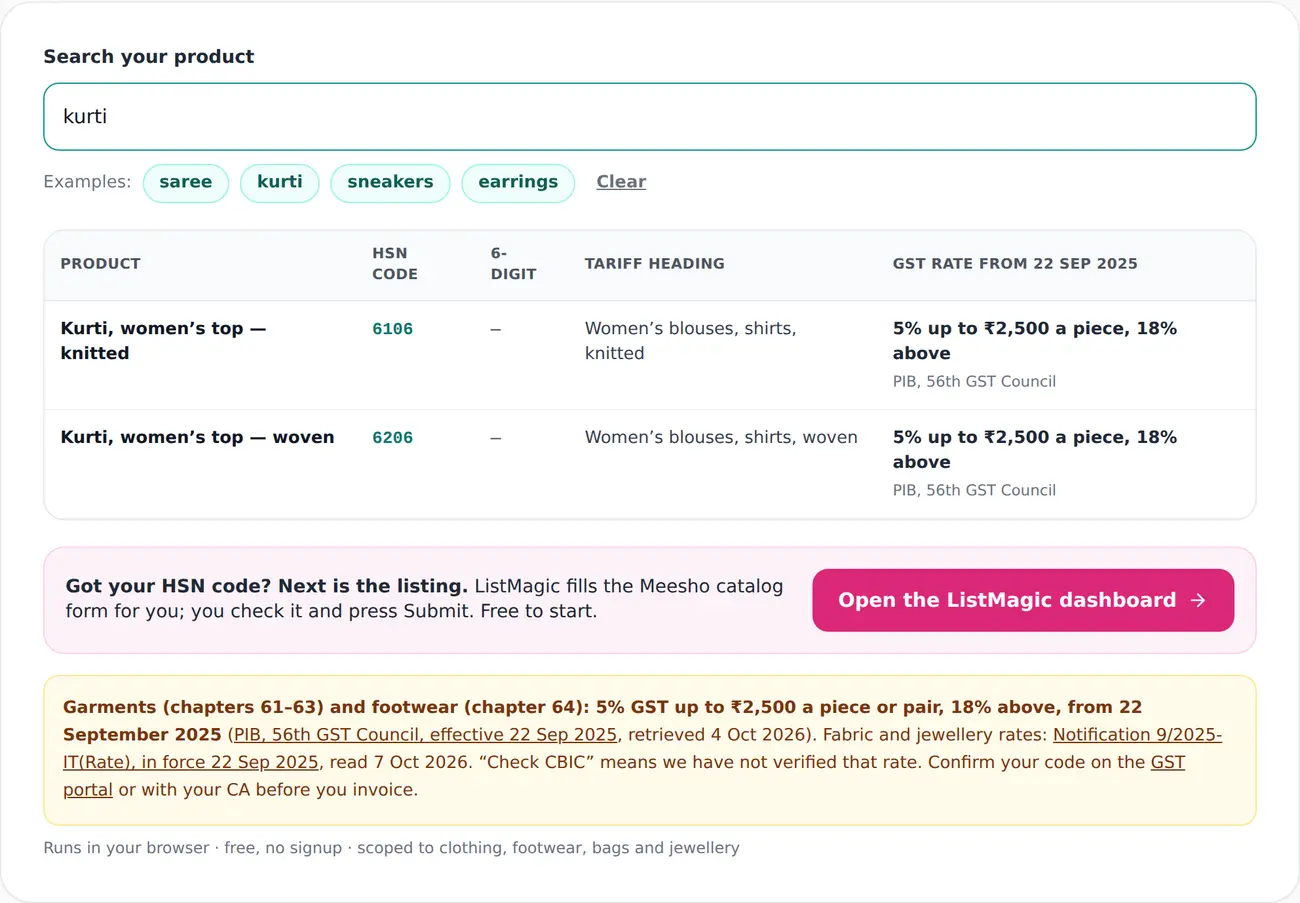
| Kurti, women’s top — knitted | 6106 | — | Women’s blouses, shirts, knitted | 5% up to ₹2,500 a piece, 18% abovePIB, 56th GST Council |
| Kurti, women’s top — woven | 6206 | — | Women’s blouses, shirts, woven | 5% up to ₹2,500 a piece, 18% abovePIB, 56th GST Council |
| Lehenga, lehenga choli | 6211 | — | Track suits, other garments not elsewhere classified | 5% up to ₹2,500 a piece, 18% abovePIB, 56th GST Council |
| Salwar suit, kurta set (stitched) | 6211 | 621142 cotton · 621143 man-made | Kurta and salwar, with or without dupatta (women’s) | 5% up to ₹2,500 a piece, 18% abovePIB, 56th GST CouncilPlain cotton set: 6211 42 19 (6211 42 11 if Lucknow chikan), GST portal HSN master, read 11 Oct 2026. 6204 is for Western suits. |
| Anarkali, gown, dress | 6204 | — | Women’s dresses | 5% up to ₹2,500 a piece, 18% abovePIB, 56th GST Council |
| Blouse (readymade, stitched) | 6206 | — | Women’s blouses, shirts | 5% up to ₹2,500 a piece, 18% abovePIB, 56th GST Council |
| Dupatta, stole | 6214 | — | Shawls, scarves, veils and the like | 5% up to ₹2,500 a piece, 18% abovePIB, 56th GST Council |
| Men’s shirt — woven | 6205 | — | Men’s shirts, woven | 5% up to ₹2,500 a piece, 18% abovePIB, 56th GST Council |
| Men’s shirt — knitted | 6105 | — | Men’s shirts, knitted | 5% up to ₹2,500 a piece, 18% abovePIB, 56th GST Council |
| T-shirt | 6109 | — | T-shirts, singlets, knitted | 5% up to ₹2,500 a piece, 18% abovePIB, 56th GST Council |
| Kids’ garments | 6111 / 6209 | — | Babies’ garments, knitted or woven | 5% up to ₹2,500 a piece, 18% abovePIB, 56th GST Council |
| Readymade garments — general | Chapter 61 (knitted) / 62 (woven) | — | Articles of apparel | 5% up to ₹2,500 a piece, 18% abovePIB, 56th GST CouncilIf no line above matches, check chapters 61 and 62 on the GST portal. |
| Footwear — leather | 6403 | — | Footwear with leather uppers | 5% up to ₹2,500 a pair, 18% abovePIB, 56th GST Council |
| Footwear — textile upper | 6404 | — | Footwear with textile uppers | 5% up to ₹2,500 a pair, 18% abovePIB, 56th GST Council |
| Footwear — rubber / plastic (sandals, flip-flops) | 6402 | — | Footwear, rubber or plastic uppers | 5% up to ₹2,500 a pair, 18% abovePIB, 56th GST Council |
| Fashion / imitation jewellery | 7117 | — | Imitation jewellery | 3%Notification 9/2025-IT(Rate), Sch. IV S.No. 14 |
| Fine jewellery (gold, silver, precious stones) | 7113 | — | Jewellery of precious metal | 3%Notification 9/2025-IT(Rate), Sch. IV S.No. 10 |
| Bangles, non-precious | 7117 | — | Imitation jewellery | 3%Notification 9/2025-IT(Rate), Sch. IV S.No. 14The 3% entry excludes bangles of lac/shellac; check lac and plastic bangles separately. |
| Handbags, clutches, wallets | 4202 | — | Trunks, cases, handbags | Check CBICHandicraft handbags, pouches and purses: 5% (PIB, 56th GST Council). Other bags: check CBIC. |
| Watch — wrist | 9101 / 9102 | — | Wrist-watches | Check CBIC |
| Scarves, mufflers — knitted | 6117 | — | Made-up clothing accessories, knitted | 5% up to ₹2,500 a piece, 18% abovePIB, 56th GST Council |
| Caps, hats, headwear | 6505 | — | Hats and other headgear | Check CBIC |
| Fabric — unstitched, general | Chapter 50–55 (by fibre) | — | Woven/knitted fabric | Check CBICWoven silk (5007) and cotton (5208–5212) fabric: 5% (Notification 9/2025-IT(Rate)). Other fibres: check CBIC. |
Got your HSN code? Next is the listing. ListMagic fills the Meesho catalog form for you; you check it and press Submit. Free to start.
Garments (chapters 61–63) and footwear (chapter 64): 5% GST up to ₹2,500 a piece or pair, 18% above, from 22 September 2025 (PIB, 56th GST Council, effective 22 Sep 2025, retrieved 4 Oct 2026). Fabric and jewellery rates: Notification 9/2025-IT(Rate), in force 22 Sep 2025, read 7 Oct 2026. “Check CBIC” means we have not verified that rate. Confirm your code on the GST portal or with your CA before you invoice.
Runs in your browser · free, no signup · scoped to clothing, footwear, bags and jewellery
Clothing in India takes 5% GST when the sale value is up to ₹2,500 a piece and 18% above it, and footwear follows the same ₹2,500 line per pair, since 22 September 2025 (56th GST Council, PIB, retrieved 4 Oct 2026). Readymade garments are chapter 61 (knitted) or 62 (woven); the HSN code does not change with the price, only the rate does.
HSN code list for clothes, footwear and jewellery with GST
| Category | Chapter / heading | GST up to ₹2,500 | GST above ₹2,500 | Source, date |
|---|---|---|---|---|
| Knitted apparel (T-shirts, knitted kurtis, leggings) | Chapter 61 | 5% | 18% | PIB, 56th GST Council, effective 22 Sep 2025 |
| Woven apparel (shirts, woven kurtis, lehengas, kurta sets) | Chapter 62 | 5% | 18% | Same |
| Made-up textile articles and sets | Chapter 63 | 5% | 18% | Same |
| Footwear (per pair) | Chapter 64 | 5% | 18% | Same |
| Handicraft handbags, pouches, purses, jewellery boxes | — | 5% | 5% | Same |
| Woven silk, cotton and man-made fabric (unstitched sarees, blouse pieces) | 5007 · 5208–5212 · 5407–5408 | 5% | 5% (no band) | Notification 9/2025-IT(Rate), Sch. I, read 7 Oct 2026 |
| Imitation (artificial) jewellery | 7117 | 3% | 3% (no band) | Same notification, Sch. IV, read 7 Oct 2026 |
What changed: before 22 Sep 2025 the higher band was 12%; the HSN codes did not change. Last verified: October 2026. Finder rows marked “Check CBIC” (non-handicraft bags, watches, headwear, other fabrics) are not in this table because we have not verified their rate.
How to find the HSN code for your product
- Type what you sell. In your words, such as “kurti”, “dupatta” or “saree”. The finder shows the code, its 6-digit sub-heading where we have it, and the rate.
- Check knitted or woven. Knitted garments are chapter 61, woven ones chapter 62; ask your supplier how the fabric is made.
- Read the band against your price. The rate follows each piece’s sale value, not the code. Work out the tax in the GST calculator.
- Copy the right number of digits. On a tax invoice: 4 digits up to ₹5 crore turnover, 6 above, from 1 Apr 2021 (Notification 78/2020-Central Tax). In the GSTR-1 HSN summary (Table 12): at least 2 digits up to ₹5 crore, 6 above, from 1 Aug 2022 (GSTN advisory, retrieved 4 Oct 2026).
HSN code for kurti in Meesho: a worked search
Kurti sold alone, or as a set
A kurti top is 6106 if knitted and 6206 if woven. Sold with a salwar, with or without dupatta, it becomes a kurta set: 6211 42 19 for plain cotton, 6211 42 11 if Lucknow chikan (GST portal HSN master, read 11 Oct 2026). The kurti HSN code page lists the 8-digit lines and the ladies suit HSN code page covers sets.
Saree, blouse piece and dupatta
We list an unstitched saree, and an unstitched blouse piece, under the woven-fabric heading for its fibre: silk 5007, cotton 5208–5212, synthetic 5407–5408, all 5% at any price (Notification 9/2025-IT(Rate), Sch. I). A pre-stitched saree is 6211, a stitched blouse 6206 and a dupatta 6214, all on the garment band. Per-fibre lines: saree HSN code.
Common HSN mistakes clothing sellers make
Putting an unstitched saree under a garment chapter
Filing a kurta-salwar set under 6204
One rate for the whole catalog
Footwear priced per pair but taxed per shoe
Sources: PIB, 56th GST Council, effective 22 Sep 2025, retrieved 4 Oct 2026; GST portal HSN master, read 11 Oct 2026.
HSN code and GST rate by product
- Clothes HSN code
- T-shirt HSN code
- Shirt HSN code
- Kurti HSN code
- Ladies suit HSN code
- Dress HSN code
- Saree HSN code
- Pant HSN code
- Jeans HSN code
- Jacket HSN code
- Fabric HSN code
- Shoes and footwear HSN code
- Bags HSN code
- Jewellery HSN code
- Artificial jewellery HSN code
- Cosmetics HSN code
- Shampoo HSN code
- Stationery HSN code
- Pen HSN code
- Toys HSN code
- Carton box HSN code
- Chair HSN code
- LED lights HSN code
- Mattress HSN code
Related seller tools
Frequently asked questions
What is the HSN code for a women’s kurti for a Meesho catalog?
6206 if the kurti is woven and 6106 if it is knitted; a kurta-salwar set is 6211 42 19 for plain cotton. GST is 5% up to ₹2,500 a piece and 18% above, since 22 September 2025 (PIB, 56th GST Council).
What is the HSN code for a blouse piece?
We list an unstitched blouse piece under the woven-fabric heading for its fibre (cotton 5208–5212, silk 5007) at 5% (Notification 9/2025-IT(Rate)). A stitched blouse is 6206. Confirm the heading on the GST portal before you invoice.
What is the dupatta HSN code?
6214, shawls, scarves, veils and the like, on the garment band (PIB, 56th GST Council). Sold with a kurta and salwar as one set, it goes under 6211 42 with the set.
What is the HSN code for clothes?
Chapter 61 if the garment is knitted, chapter 62 if it is woven; the 4- or 6-digit heading depends on the garment type. Search the product in the finder for the exact code.
How many digits of HSN code do I put on an invoice?
4 digits up to ₹5 crore turnover and 6 above, from 1 April 2021 (Notification 78/2020-Central Tax). The GSTR-1 HSN summary asks for at least 2 digits up to ₹5 crore and 6 above, from 1 August 2022 (GSTN advisory).
HSN code kya hota hai?
HSN code ek classification code hai jisse GST rate tay hota hai. Kapdon ke liye chapter 61 ya 62; rate ₹2,500 tak 5%, usse upar 18% (22 Sep 2025 se, PIB).
StitchMagic is a set of free tools and one AI listing agent (ListMagic) for online sellers in India that helps them list faster on Meesho, Flipkart and Amazon.in and sell more.