Meesho seller calculator: commission, payout and profit per order
By StitchMagic team · Last checked 4 October 2026
Listing on Meesho? ListMagic fills the catalog form for you. Free to start.
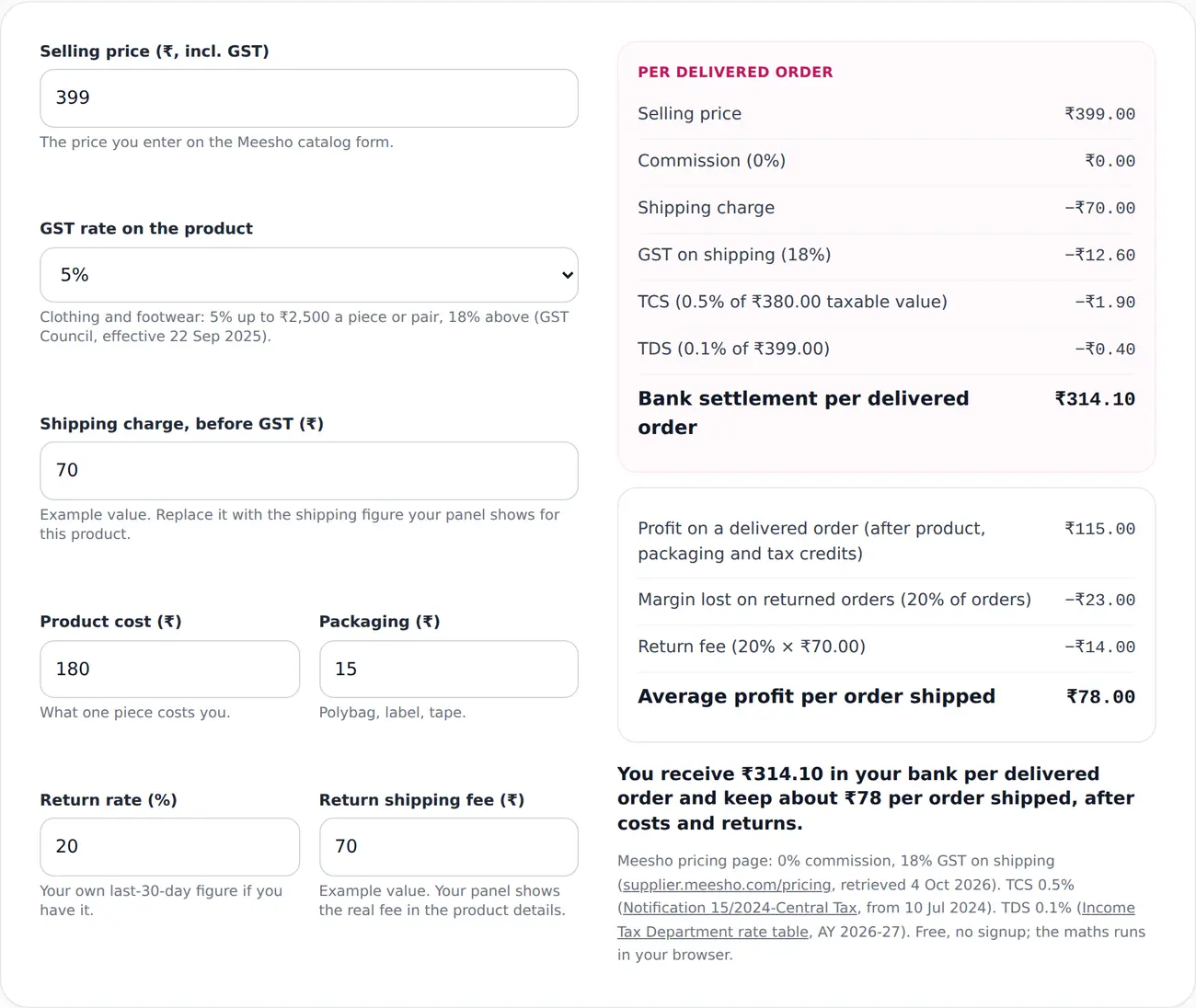
Per delivered order
You receive ₹314.10 in your bank per delivered order and keep about ₹78 per order shipped, after costs and returns.
Meesho pricing page: 0% commission, 18% GST on shipping (supplier.meesho.com/pricing, retrieved 4 Oct 2026). TCS 0.5% (Notification 15/2024-Central Tax, from 10 Jul 2024). TDS 0.1% (Income Tax Department rate table, AY 2026-27). Free, no signup; the maths runs in your browser.
ListMagic fills the Meesho catalog form for you, price included. Free to start.
On Meesho, the payout per delivered order is the selling price minus the shipping charge, 18% GST on that shipping, 0.5% TCS and 0.1% TDS, because Meesho charges 0% commission on every category (Meesho pricing page, retrieved 4 Oct 2026). A ₹399 kurti at 5% GST with a ₹70 shipping charge pays ₹314.10 into your bank, on the 7th day from delivery.
Meesho seller se kitna commission leta hai? 0%: Meesho kisi bhi category par commission nahi leta (pricing page, 4 Oct 2026). Aapke payout se sirf shipping, us par 18% GST, 0.5% TCS aur 0.1% TDS katta hai. Apna payout kaise check kare? Upar selling price aur Supplier Panel wala shipping charge daaliye.
Worked example
Meesho profit calculator: a ₹399 kurti
What the numbers mean
- ₹0 commission: Meesho charges 0% on every category.
- ₹12.60 GST on shipping: 18% of the ₹70 shipping charge.
- ₹2.30 TCS and TDS: 0.5% of ₹380 plus 0.1% of ₹399, both claimable back.
- ₹314.10 bank settlement: ₹399 − ₹70 − ₹12.60 − ₹2.30, paid on the 7th day from delivery.
- ₹115 profit on a delivered order: ₹380 taxable value − ₹70 shipping − ₹180 cost − ₹15 packaging, with GST on shipping, TCS and TDS claimed back.
- ₹78 average per order shipped: at 20% returns, 0.8 × ₹115 − 20% × ₹70 return fee.
StitchMagic example; rates from the Meesho pricing page, retrieved 4 Oct 2026. The ₹70 shipping and ₹70 return fee are example inputs, not Meesho rates.
How to use the Meesho commission calculator
- 1
Type your selling price
The price on your catalog form, GST included. Commission stays at ₹0: Meesho charges 0% across all categories (pricing page, 4 Oct 2026). - 2
Pick the GST rate
Kurtis, sarees sold as garments and shoes up to ₹2,500 take 5%, above that 18% (GST Council, effective 22 Sep 2025). Unsure of the code? Use the HSN code finder. - 3
Copy shipping from your panel
Meesho charges the seller for forward shipping (how-it-works page, 4 Oct 2026). How it is worked out: Meesho shipping charges guide. - 4
Add costs and returns
Enter product cost, packaging, your return rate and the return fee shown in the product details.
Meesho commission rate and fees the calculator uses
| Charge | Rate used | Where it comes from | Source, date |
|---|---|---|---|
| Commission | 0% | Fixed | Meesho pricing page, 4 Oct 2026 |
| Payment gateway / COD collection fee | ₹0 | Fixed | Meesho pricing page, 4 Oct 2026 |
| Forward shipping | Your input | Shown in your Supplier Panel per product | Meesho how-it-works, 4 Oct 2026 |
| GST on shipping | 18% | Fixed | Meesho pricing page, 4 Oct 2026 |
| TCS (GST, section 52) | 0.5% of taxable value | Fixed by law | PIB, Notification 15/2024-CT, effective 10 Jul 2024 |
| TDS (income tax, section 194-O) | 0.1% of gross amount | Fixed by law | Income Tax Department TDS rates, AY 2026-27 |
| Return shipping fee (customer return) | Your input | By weight, shown in product details | Meesho shipping page, 4 Oct 2026 |
| RTO (undelivered parcel) | ₹0 | Fixed | Meesho pricing page, 4 Oct 2026 |
| Payout day | 7th day from delivery | Fixed | Meesho how-it-works, 3 Oct 2026 |
Last verified: October 2026.
What changed
TCS dropped from 1% to 0.5% on 10 July 2024 (Notification 15/2024-Central Tax). Garment and footwear GST moved to 5% up to ₹2,500 and 18% above on 22 September 2025 (56th GST Council, PIB). Meesho’s 0% commission was unchanged when we checked on 4 Oct 2026.Why your Meesho payout is lower than the price
Settlement ₹12–13 lower than price minus shipping
A few rupees missing on every order
Profit gone in a heavy-return week
GST paid at 18% on a ₹2,400 kurti
Sources: Meesho pricing and shipping pages, retrieved 4 Oct 2026; PIB, 56th GST Council, effective 22 Sep 2025. Next: pack smaller to cut shipping and Meesho returns for sellers.
What the calculator includes, and what it leaves out
Included
The charges Meesho and the tax law apply to every order: 0% commission, shipping with 18% GST, TCS and TDS (rates retrieved 4 Oct 2026).
Left out
Meesho Ads spend, GST on your packaging purchases, and a seller without a GSTIN, who joins with an Enrolment ID / UIN (Meesho how-it-works, 3 Oct 2026) and whose tax lines differ. If you run ads, treat the profit line as a ceiling.
Related seller tools
Frequently asked questions
Does Meesho charge commission?
No: Meesho’s pricing page says it charges 0% commission across all categories (retrieved 4 Oct 2026). Your costs on Meesho are shipping, GST on shipping and the TCS/TDS the law requires.
How is Meesho payout calculated?
Selling price minus the shipping charge, 18% GST on that shipping, 0.5% TCS on the taxable value and 0.1% TDS on the gross amount. On a ₹399 kurti with ₹70 shipping that comes to ₹314.10.
Is GST charged on Meesho shipping charges?
Yes, 18%, as Meesho’s pricing page states (retrieved 4 Oct 2026). A GST-registered seller can claim it back as input tax credit.
Why is TCS and TDS deducted from my Meesho payment?
The law makes every marketplace collect them: TCS at 0.5% under GST since 10 Jul 2024 and TDS at 0.1% under income tax. Both come back as credits when you or your CA file.
When does Meesho pay sellers?
On the 7th day from delivery, Cash on Delivery orders included (Meesho how-it-works page, checked 3 Oct 2026). The Payments tab of the Supplier Panel shows the next payment.
Does Meesho charge for returns?
A customer return costs a return shipping fee based on weight; an undelivered parcel (RTO) costs nothing (Meesho shipping and pricing pages, 4 Oct 2026). Enter your return rate so the calculator counts it.
Rates checked on Meesho’s pricing and how-it-works pages on 3–4 October 2026, and the tax rates on the PIB and Income Tax Department pages linked above. If your Supplier Panel shows a different figure, trust the panel and enter it.
StitchMagic is a set of free tools and one AI listing agent (ListMagic) for online sellers in India that helps them list faster on Meesho, Flipkart and Amazon.in and sell more.