What each deduction actually is
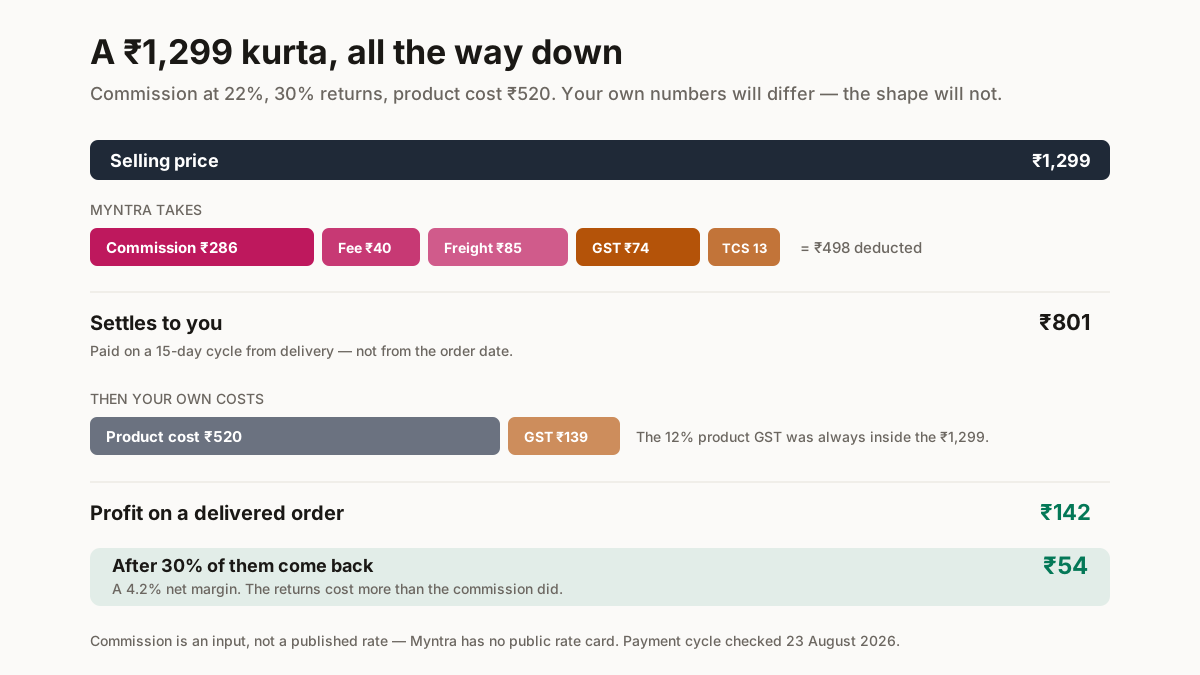
Seven things stand between the price on the listing and the money that reaches your account, and they are not all fees.
Commission
A percentage of the selling price, set by category and price band in your agreement. It is the largest single deduction on most fashion orders and the one you have least visibility on before onboarding.
Fixed fee and forward logistics
A per-order charge plus the cost of getting the parcel to the customer, billed on chargeable weight — the greater of actual and volumetric. A light kurti in an oversized bag is charged on the bag.
Growth enablement
A one-time charge for new sellers, applied once you start operating. Myntra nets it off your payout and returns its value as product listing ad credits rather than cash. It is not an onboarding fee — Myntra charges none — but it does mean some of your first payouts arrive as advertising instead of money. Spread it across your expected early orders in the field above.
GST on the fees
18% on Myntra’s charges, not on your product. This is the line sellers forget: you pay tax on the commission as well as the commission.
TCS
Withheld at source and reclaimable in your GST return — so it is a cash-flow cost rather than a permanent one, but it is out of your account in the meantime.
GST on your product
Already inside the price you set. Apparel is commonly 5% under ₹1,000 and 12% above, which means crossing ₹1,000 quietly moves the tax bracket against you.
Why there is no commission table on this page
Because Myntra does not publish one, and every page that shows you a Myntra rate card made it up.
That is worth being precise about. Amazon and Flipkart publish detailed, category-by-category fee schedules you can check. Myntra does not. Commission is set in the Commercial Terms Agreement you see when you are onboarded, and it varies by category, by price band and by what your brand negotiates.
The result is that the figures circulating online disagree wildly — one guide will tell you 4 to 5%, the next 0 to 30%, and neither cites anything. A calculator built on either would be confidently wrong, and a wrong calculator is worse than none because nobody notices it has drifted.
So the field above is yours to fill from your own agreement. If you have not been onboarded yet, the honest answer is that you do not know your rate and cannot — model a range instead, and see how sensitive your margin is to it.
The one published exception
Myntra runs a zero-commission construct for digital-first, made-in-India D2C brands under its Rising Stars programme. If you currently sell through your own site or social channels, that is a genuine 0% and it is worth asking about by name. Set commission to 0 above to see what it does.
Returns are the whole game
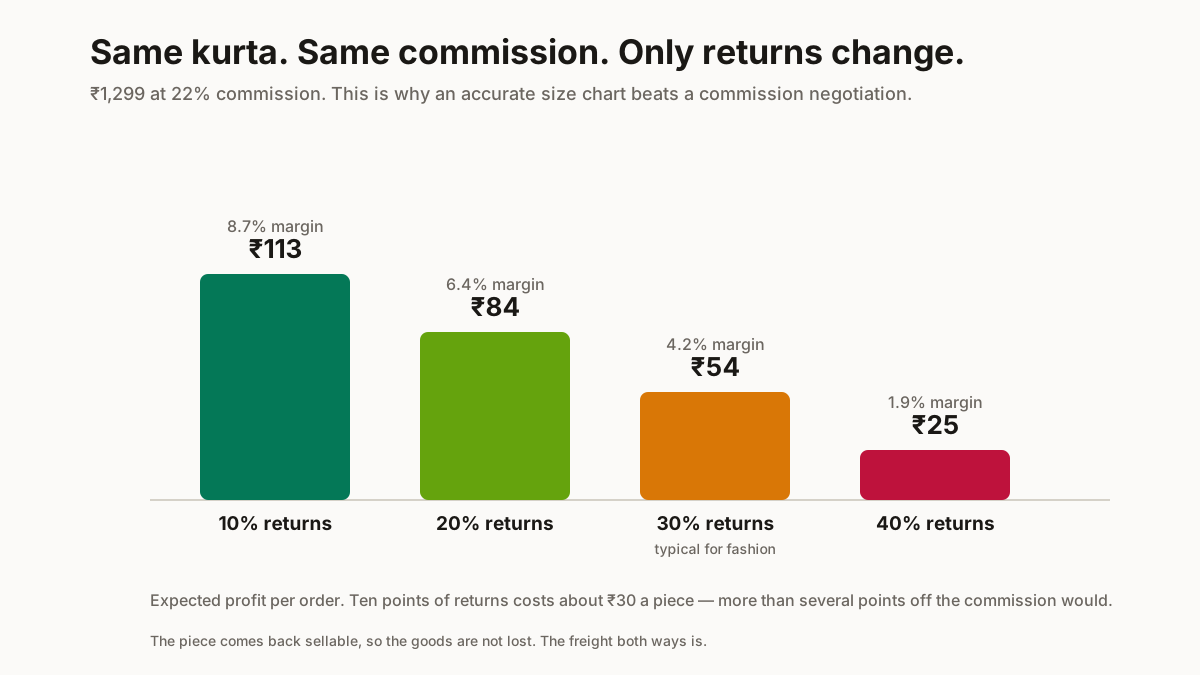
Change the commission field by five points and watch the margin move. Now change the return rate by five points and watch it move further. That is the entire lesson of this page.
Fashion returns are high everywhere and apparel is the worst of it — size, fit and colour are all things a customer cannot check before buying. A rate of 25 to 40% is normal on Myntra, not pessimistic, and the default here is set at 30 for that reason.
A returned order does not just lose the sale. You pay freight out and freight back, you lose whatever ad spend won the click, and the piece comes back needing inspection and repacking before it can sell again. What you keep is the goods — which is why the calculation above returns the product cost on a return but not the shipping.
The practical consequence: an accurate size chart is worth more than a commission negotiation. Cutting returns from 30% to 20% moves the margin further than several points off the rate, and it is entirely within your control. Our size chart generator is the cheapest lever on this page.
The same kurti on Myntra, Meesho and Flipkart
Run the same product through all four calculators before you decide where it belongs, because the answer genuinely differs by product rather than by platform.
The short version: Myntra suits a higher price point. Its commission is meaningful, but so is its customer’s willingness to pay, and a ₹1,299 kurta that would never sell on Meesho can work here. Meesho suits volume at a low ticket, where its commission structure is gentler but the price ceiling is real. Flipkart sits between them with the widest category coverage.
What decides it is where your product sits, not which platform is cheapest in the abstract. A ₹399 nightie and a ₹2,499 lehenga want different homes, and the calculators will tell you which faster than a year of trying.
Compare directly: Meesho, Flipkart, Amazon. And if you have not sourced the stock yet, what it costs in bulk sets the floor under all of this.
Before you rely on this
The arithmetic here is exact; the inputs are yours. That split is deliberate and it is the only honest way to build a marketplace calculator, because every rate in the model moves per category and per quarter.
Two figures Myntra does publish, and which this page uses: settlement runs on a 15-day cycle from the date of delivery to the customer, not from the order date — so plan cash flow around roughly three weeks from sale to money. And Myntra charges no onboarding fee or refundable deposit; anyone asking you for one is defrauding you.
Everything else — commission, fixed fee, logistics slabs — comes from your own agreement and your own settlement reports. Take them from there rather than from any page, including this one.
Related free seller tools
Frequently Asked Questions
What commission does Myntra charge sellers?
Myntra does not publish a category rate card. Your commission is set in the Commercial Terms Agreement you receive when onboarded, and varies by category, price band and negotiation. Figures quoted online range from 4% to 30% and none of them cite a source, which is why this calculator asks for yours instead of assuming one.
Are there registration charges to sell on Myntra?
No. Myntra states plainly that it charges no onboarding fee and no refundable deposit, and warns that people impersonating its staff ask for exactly that. There is a one-time growth enablement charge once you begin operating, but it is netted off your payout and returned as product listing ad credits rather than invoiced up front.
When does Myntra pay sellers?
On a 15-day settlement cycle counted from the date the product is delivered to the customer, not from the order date. Adding shipping time, plan for roughly three weeks between the sale and the money — longer if the order goes through a return cycle first.
Who pays for returns on Myntra?
You absorb the logistics on a returned order in most arrangements, which is why the return field matters more than the commission field. The goods usually come back sellable, so the product cost is not lost, but the freight both ways and any ad spend that won the click are gone.
Is GST deducted from my Myntra payout?
Two separate things happen. GST at 18% is charged on Myntra’s fees, which increases the deduction. Separately, the GST on your product is already inside the price you set and you remit it — apparel is commonly 5% under ₹1,000 and 12% above, so crossing ₹1,000 shifts the bracket against you.
What is the Myntra zero commission programme?
A 0% commission construct for digital-first, made-in-India D2C brands, run under Myntra Rising Stars and aimed at brands currently selling through their own site or social channels. It is the one published commission figure Myntra has. Set the commission field to 0 above to see the effect.
No rate is hardcoded in this calculator. The payment cycle and the no-onboarding-fee position come from Myntra’s own partner portal, checked 23 August 2026. Commission, fees and logistics slabs are yours to enter from your Commercial Terms Agreement and settlement reports — a calculator with a marketplace rate baked in is wrong within months and nobody notices.