What you are buying, and what it costs
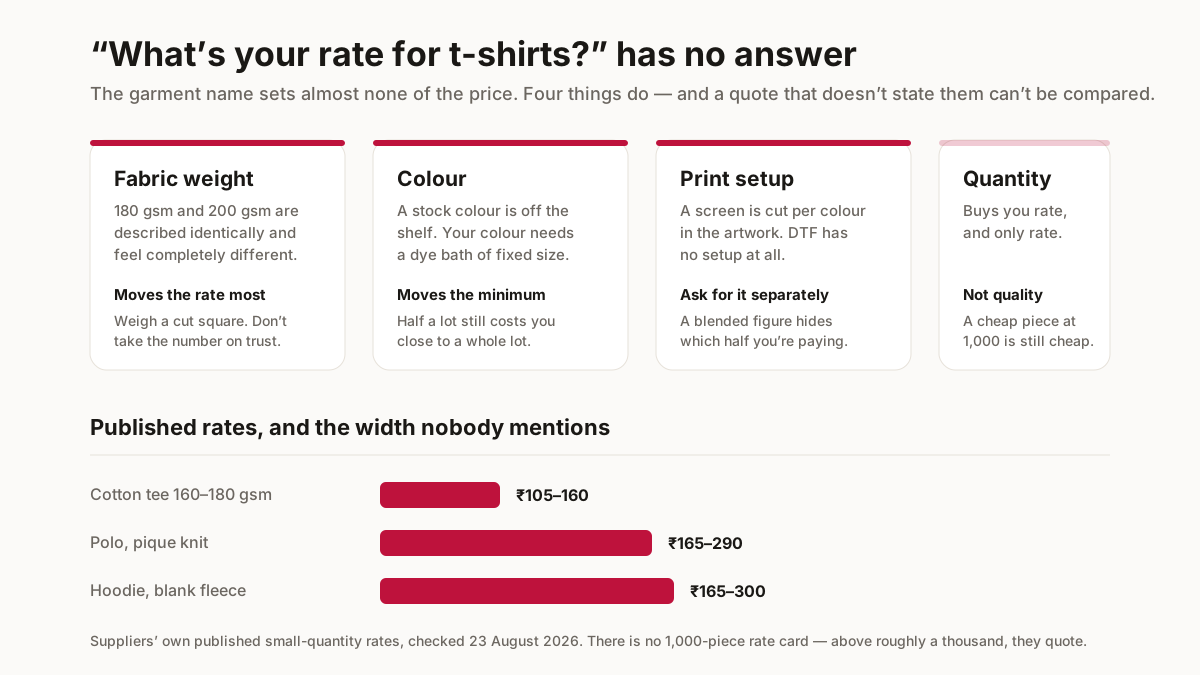
The first thing worth knowing is that there is no price for a t-shirt. There is a price for a 180 gsm single-jersey tee in a stock colour at 200 pieces, and a different price for the same shape at 200 gsm in a colour dyed for you. Sellers who ring round asking “what is your rate for t-shirts” get a number that means nothing, and then compare two numbers that were never for the same garment.
So the bands below are here to do one job: tell you whether a quote you have been given is roughly sane. They are not quotes, and treating them as a target to negotiate down to will mostly get you worse goods rather than a better rate.
| Item | Per piece, small quantity | What moves you within the range |
|---|---|---|
| Round-neck cotton tee, 160–180 gsm | ₹105–160 | Gsm, bio-wash or not, colour |
| Cotton tee, 200–220 gsm | ₹150–220 | The same, plus yarn quality |
| Oversized tee | ₹195–300 | Gsm, and the drop of the cut |
| Polo, pique knit | ₹165–290 | Gsm, collar quality, tipping |
| Hoodie, blank fleece | ₹165–300 | Fleece weight, zip or pullover |
| Kurti, printed | From ₹99 | Fabric and the work on it — the spread is enormous |
| Jeans, basic denim | ₹125–650 | Surplus lot at the bottom, made-to-order at the top |
| Saree | No useful single figure — published Surat rates run from about ₹100 to ₹5,500, set almost entirely by the fabric. Daily-wear printed sits near the bottom, Banarasi silk and heavy wedding pieces at the top. | |
Per piece, before GST and freight, from suppliers’ own published rates and checked 23 August 2026. Ranges, not quotes. Note there is no thousand-piece column: suppliers publish a small-quantity range and quote individually above roughly a thousand, so any site showing you a neat rate card at 1,000 pieces has made it up.
Notice what is missing: a thousand-piece column. Suppliers publish a small-quantity range and then quote individually above roughly a thousand pieces, so any rate card showing you a clean figure at 1,000 has invented it. What quantity actually buys you is a quote, and the quote improves — but quantity buys you rate, and rate is the only thing it buys. It does not buy you quality, and a cheap piece at 1,000 is still a cheap piece.
The width of each range is the real lesson. A tee at ₹105 and a tee at ₹160 are both honestly described as a plain cotton tee; what separates them is gsm, whether it has been bio-washed, and the yarn. That is why the third column matters more than the second, and why a quote without a specification attached cannot be compared with anything.
Two costs sit outside the table and catch people out. GST is charged on top, and freight on 200 hoodies from Ludhiana is not the same line item as freight on 200 tees from Tirupur. Put both into your costing before you decide what you can sell at — the break-even price calculator takes them as inputs.
How much do you actually have to buy?
The belief that wholesale means a hundred pieces stops more new sellers than the real minimums do. Ready stock — something the supplier already has folded on a shelf — will frequently go at a dozen, because you are buying an existing thing rather than asking anyone to start a machine.
Minimums exist where a process has to be set up for you. A dye bath is a fixed size, so half a lot of your colour still costs close to a lot. A screen has to be cut per colour in the artwork, so a 3-colour print is 3 setups whether you order 50 or 500. Once you know which of those you are triggering, the number stops looking arbitrary.
| What you are asking for | Usual minimum | What sets it |
|---|---|---|
| Ready stock, off the shelf | A dozen | Nothing — it already exists |
| Plain tees in stock colours | 25 a colour | Lower than most sellers expect; published, not negotiated |
| Tees dyed to your colour | 200–300 a colour | The dyeing lot; half a lot still costs a lot |
| Screen-printed tees | 50–100 a design | Screen setup, charged per colour in the artwork |
| DTF or digital printed tees | From about 10 | No setup, so the floor is low and the piece rate high |
| Hoodies and sweatshirts | From 100 | Fleece is knitted and dyed in larger lots |
| Jeans | 50, and 500 at some brands | Wash lot and pattern grading |
| Sarees | A parcel value, not a count | Surat wholesalers often set a ₹10,000–₹20,000 minimum parcel instead |
| Cut-and-sew to your pattern | 200–500 a style | Fabric roll width and line time |
From suppliers’ published terms, checked 23 August 2026. Typical, not fixed — minimums are a supplier’s preference far more often than a hard rule.
The number that surprises people most is the tee minimum. Tirupur houses publish 25 pieces a colour, not the hundred that gets repeated everywhere, and it is published rather than negotiated — you do not have to ask for a favour to get it.
There are three honest ways under a minimum. Buy ready stock instead of made-to-order and take the colours that exist. Buy a surplus lot — an export overrun or a cancelled order — which is cheap and genuinely good, but comes in whatever size ratio it comes in. Or use a route with no setup at all: DTF printing has no screens, so ten pieces is a real order.
Sarees work differently again. Surat wholesalers frequently set a minimum parcel value rather than a piece count — commonly in the ₹10,000 to ₹20,000 range — so the question is not how many sarees but how much, and a mixed parcel across designs usually counts.
What does not work is asking a unit to break a dye lot as a favour. If they agree, you are usually paying the full lot spread over your pieces anyway.
Which category are you buying?
This page is the hub. Each category has its own sourcing logic — a different set of hubs, a different thing that decides quality, a different way the trade tiers — and those live on their own pages rather than being compressed into a paragraph here.
Where to buy: market, online, or direct from a unit
Three routes, and the right one depends far more on your quantity and your appetite for risk than on price.
| Market in person | Online wholesale | Direct from a unit | |
|---|---|---|---|
| Price | Good, and negotiable | Highest — a layer sits in it | Best at volume |
| Quantity | Smallest | Small | Largest |
| You see the goods | Before paying | After paying | Only as a sample |
| Customising | None | None | The whole point |
| Lead time | Same day | Days | Weeks |
| Main risk | A wasted trip | Goods unlike the photo | A run made wrong |
Going to a market is still the best first move, and the reason is simple: you handle the goods before any money changes hands. That single fact removes most of what goes wrong in sourcing. The trade concentrates by category, so the trip is only worth taking to the right place — Tirupur for knits and tees, Surat for synthetic sarees and dress material, Ludhiana for winterwear and hosiery, Delhi for ready-made range, Kolkata for cotton weaves.
Online wholesale is where you pay a premium for not travelling, and where the photograph is the only thing you get to inspect. It works for repeat orders of something you have already handled. It works badly for a first purchase from a supplier you have never met.
Direct from a unit is a different relationship, not a cheaper version of the same one — you are buying capacity rather than stock, and it is covered properly in the garment manufacturing guide.
Vetting a supplier before you pay
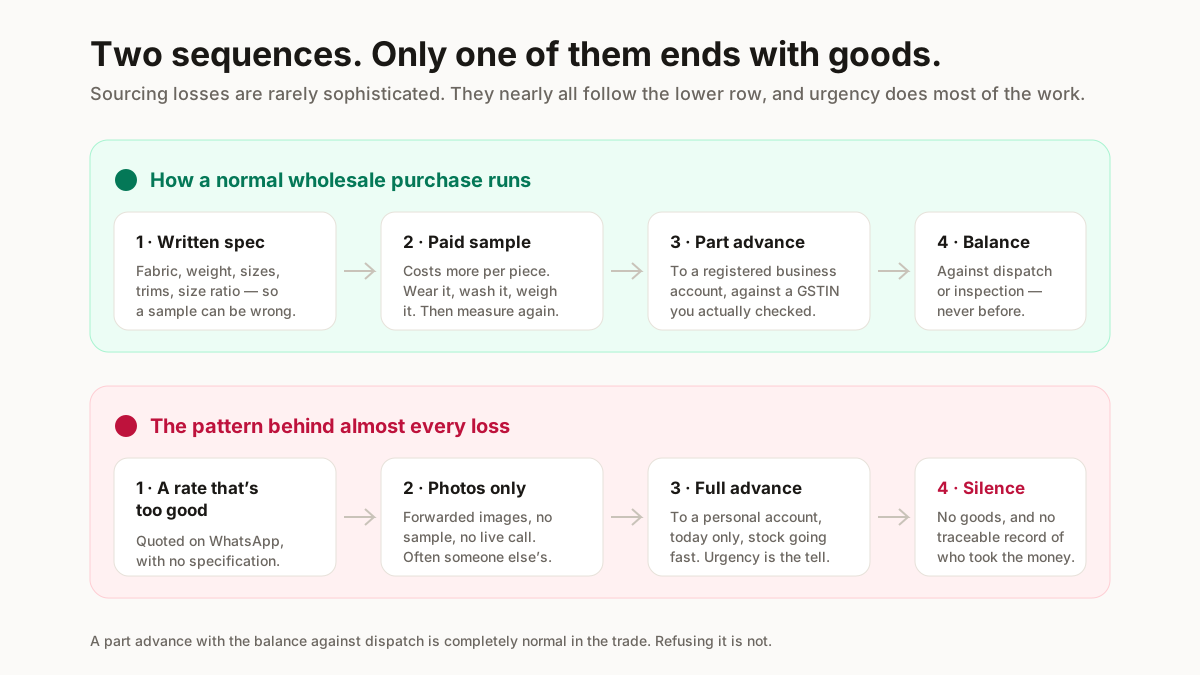
Almost every sourcing loss follows the same shape. A good rate over WhatsApp, photographs that turn out to be someone else’s, a full advance to a personal account, and then a phone that stops being answered. It is not sophisticated, and it keeps working because a new buyer feels awkward asking for proof.
Ask for the GSTIN, and check it
A wholesaler trading at any real volume is registered, and a supplier who cannot produce a GSTIN has told you something. Check the number rather than just collecting it — the digits encode the state and the PAN, so a wrong one is visible without a portal.
Get a sample against your written spec
Not a sample of whatever they have. A sample of what you are ordering, described in writing first, so the sample can be right or wrong rather than merely nice.
See the goods on a video call
Live, not a forwarded clip, and ask them to move the camera. It takes 5 minutes and it defeats stolen photographs entirely.
Never send the full amount in advance
Note that a large advance is normal and is not the warning sign. Tirupur units commonly publish 75% on order confirmation and 25% on completion for made-to-order work, because they are buying your fabric before they sew anything. That is a legitimate structure.
What is not legitimate is 100% up front, to a personal account, with urgency attached. The distinction is not the size of the advance — it is whether anything at all is held back against you actually receiving the goods, and whether the account belongs to a registered business. Urgency is doing most of the work in the scam.
Pay in a way that leaves a record. A transfer to a registered business account is traceable; cash handed over on a phone call is not.
Getting the sample right
Paying for a sample feels like a cost you can skip when the rate is already agreed. It is the cheapest insurance in sourcing, and the pieces sellers regret are almost always the ones bought from a photograph.
Expect to pay more per piece for it, sometimes several times the bulk rate, and expect that to be adjusted against the order if you place one. That is normal and not a bad sign.
What to check when it arrives
Weight. Gsm is the number most often overstated. A 180 gsm tee and a 160 gsm tee are described identically and feel different in the hand — the gsm calculator settles it from a cut square and a kitchen scale.
Shrinkage. Measure it, wash it as your customer will, measure it again. Cotton that has not been pre-shrunk comes back a size down, and every size chart you build on the unwashed piece will be wrong.
Stitching and colour fastness. Pull at the seams and the slit. Wash a light piece with a dark one and see what moves.
Then put the specification in writing before the bulk order — fabric and weight, measurements at every size, trims, and the size ratio you want. A run weighted wrongly across sizes leaves you out of stock in the sizes that sell and holding the ones that do not, which is a slower and more expensive failure than a bad print.
Bulk t-shirt printing
Printing is a separate decision from buying, and it changes your minimum more than it changes your rate. Three methods matter.
Screen printing is the cheapest per piece at volume and the most expensive to start, because a screen is cut for each colour in the artwork. It suits a simple design in quantity. A photographic image with a dozen colours is the wrong job for it.
DTF — a transfer printed and heat-pressed on — has essentially no setup, handles full colour, and costs the same on the tenth piece as the five-hundredth. It is what makes a ten-piece order possible at all, and it is why a small seller testing a design should almost always start here.
Sublimation dyes the fibre rather than sitting on it, so the print does not crack and does not fade — but it only works on polyester and only on light fabric. On a cotton tee it is not an option.
The rule of thumb: below about 50 pieces DTF wins on total cost even though its piece rate is higher, and somewhere past a hundred the screen setup has paid for itself. Ask for the setup charge and the per-piece rate as two separate numbers, because a single blended figure hides which one you are actually paying.
Printing also resets your minimum. A supplier happy to sell 20 plain tees may need 50 to print them, and that is the screen talking rather than the stock.
Who should you actually buy from?
The suppliers worth returning to are the ones who will deal at your quantity and whose goods hold up. Neither of those is visible from a search result, and both are learned by buying small first.
Bulk apparel supplier list
We are building a list of bulk apparel suppliers by category and by the smallest lot each will sell, because a knitwear unit and a saree wholesaler are different businesses entirely. Every number on it comes from a supplier who asked to be listed.
Your number is used to send the list and nothing else.
The stock arrives. Now the listing.
After the trip
A bulk lot is a hundred listings waiting to be made
Every piece needs photographing, sizing to each portal and renaming before any of it earns. StitchMagic clears the image half — repair, four marketplace sizes, renaming — in one pass.
- Repairs and sharpens the photo
- Exports the 4 marketplace sizes from one upload
- Keeps the primary image clean, so QC does not bounce it
- Renames every file to its SKU
- Builds the WhatsApp PDF catalogue
Is it actually free?
Single photos are free. No signup, no watermark, no daily limit.
Do my photos get uploaded?
No. It runs in your browser — the files never leave your phone.
Is it a subscription?
No. The bulk pack is a one-off ₹99, and one photo counts once.
Runs on your phone, and the photos never leave it.
Related free seller tools
Frequently Asked Questions
What is the minimum order for t-shirts in bulk?
Lower than most sellers think. Tirupur knitwear houses publish 25 pieces a colour for plain tees in stock colours, and ready stock will often go at a dozen. Dyeing to your own colour pushes it to 200 or 300 because a dye lot is a fixed size, and screen printing adds its own floor of around 50 a design. DTF printing has no setup at all, so ten pieces is a genuine order.
Where is the cheapest place to buy clothes in bulk in India?
Cheapest depends entirely on the category, because production concentrates by fabric. Tirupur leads on knitwear and plain tees, Surat on synthetic sarees and dress material, Ludhiana on woollens and hosiery, Delhi on ready-made range. Buying the right category in the wrong city costs more than any negotiation will save you.
Do I need GST to buy wholesale?
You can buy without it, and many small resellers do. What you lose is the input tax credit on the GST charged to you, which is a real cost once your volumes are meaningful, and some larger suppliers will only invoice a registered buyer. It is worth having before you are buying at scale rather than after.
How do I avoid getting cheated by a wholesale supplier?
Ask for the GSTIN and check it, get a sample against a written specification rather than a sample of whatever they have, see the actual goods on a live video call, and never pay the full amount in advance to a personal account. A part advance with the balance against dispatch is normal in the trade; insistence on the whole sum up front with urgency attached is the pattern behind most losses.
How much does a plain t-shirt cost wholesale in India?
Published Tirupur rates run about ₹105 to ₹160 a piece for a round-neck cotton tee at 160 to 180 gsm, rising to roughly ₹150 to ₹220 at 200 to 220 gsm and ₹165 to ₹290 for a pique polo. The spread inside each band is gsm, whether the fabric has been bio-washed, and yarn quality — which is why a quote without a specification attached cannot be compared with another quote.
What is the wholesale price of a saree?
There is no useful single figure, and any page giving you one is guessing. Published Surat rates run from about ₹100 for a basic daily-wear printed piece to ₹5,500 for velvet wedding or Banarasi silk, set almost entirely by the fabric. Decide the fabric first and the price follows; Surat wholesalers also often set a minimum parcel value of ₹10,000 to ₹20,000 rather than a piece count.
Is it normal to pay 75% in advance to a wholesale supplier?
For made-to-order work, yes. Tirupur units commonly publish 75% on order confirmation and 25% on completion, because they buy your fabric before they sew anything. A large advance is not the warning sign. The warning sign is 100% up front to a personal account with urgency attached — what matters is whether anything at all is held back against you actually receiving the goods.
Can I get custom sizes or my own label made?
Yes, but that is manufacturing rather than wholesale buying, and it works differently — higher minimums, weeks of lead time, and a paid sample before any bulk. Most sellers should buy existing stock until a style is reliably selling out, then move to their own production. The garment manufacturing guide covers the process properly.
How much cheaper is buying 1,000 pieces than 50?
Nobody publishes that number, which is itself the answer. Suppliers list a range for small quantities and quote individually above roughly a thousand pieces, so a site showing you a neat per-piece rate at 1,000 has made it up. Expect a better quote, ask for it in writing, and remember that quantity buys you rate and nothing else — a thousand pieces of something that does not sell is a worse outcome than fifty that do.
The rate bands on this page are indicative and dated (23 August 2026); no supplier name or supplier-specific quote appears. Rates move with the cotton price, the dye colour, the print and the season, so use them to sanity-check a quote and confirm the real number directly before you commit money.