Which Surat market should you go to?
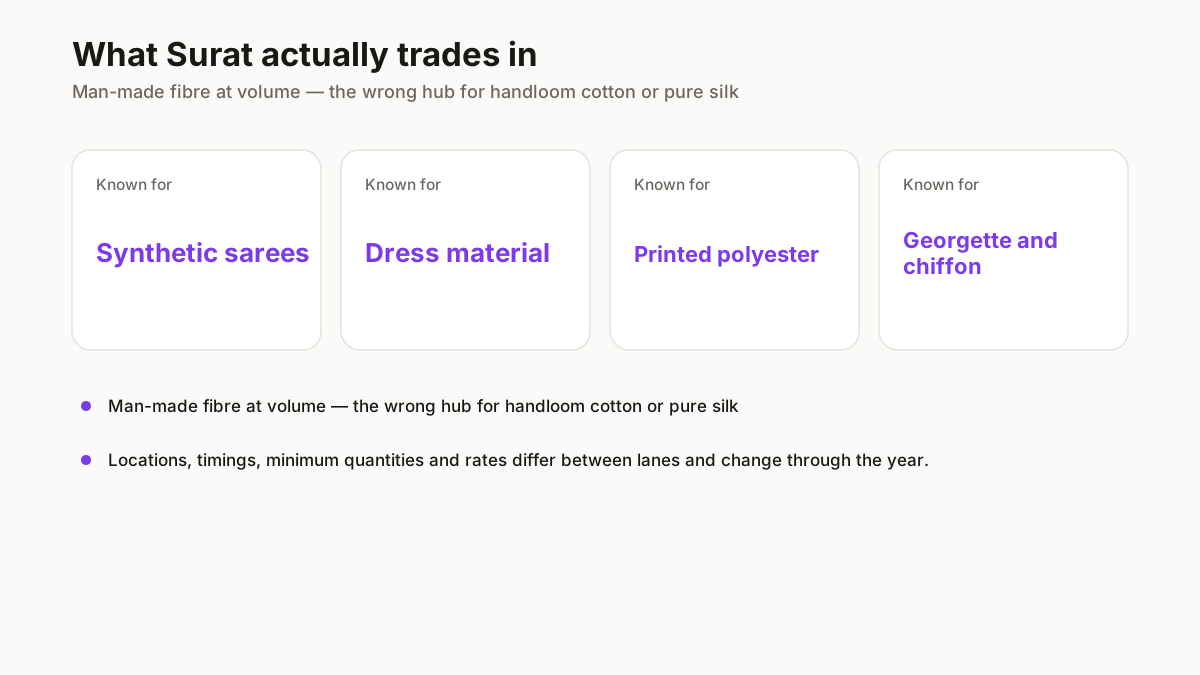
Surat is one trade rather than four, which makes it simpler than Delhi and narrower. The whole city works in man-made fibre — synthetic sarees, dress material and printed fabric — at a scale no other Indian hub matches.
The concentration is around the Ring Road textile markets, where thousands of shops sit in adjoining complexes selling broadly similar goods. That density is the advantage: you can compare ten suppliers in an afternoon without leaving one building, which is impossible in a city where markets are scattered.
It also means the risk is different. In Delhi you can go to the wrong market; in Surat you can go to the wrong city. If your customers buy handloom cotton or pure silk, no amount of walking here will find it, and that is worth knowing before you book a ticket.
Where do you sell? That decides what you buy
Surat suits a volume seller, which points at Meesho more than anywhere else. Printed sarees and dress material at everyday prices are exactly what a price-comparing buyer searches for, and the range here supports the depth a marketplace listing needs to stay in stock.
The exception is heavier worked pieces. Anything with real embellishment sells better on Instagram and WhatsApp, where no commission comes out of a higher price and a buyer will look at four photographs before deciding.
Dress material is its own case. An unstitched set needs explaining, which a marketplace listing does badly and a WhatsApp conversation does well — so sellers moving unstitched goods often do better with an audience than with search.
| Meesho | |||
|---|---|---|---|
| Buyer arrives | Searching and comparing on price | Discovering while scrolling | Already knows and trusts you |
| Marketplace commission | Yes — set by category | None | None |
| Return rate | Highest of the three | Middle | Lowest — she knows you |
| Listing rules | Strict QC, primary image must be clean | None | None |
| What sells | Everyday basics at sharp prices | Distinctive, photogenic, occasion wear | Mid to premium, and repeat orders |
| What it needs from you | Volume and price discipline | A look and consistent posting | An audience you already built |
Commission rates differ by category and change — read yours from the channel’s own rate card, and run it through the break-even calculator.
How do you get there and get around?
Surat is well connected by train and by air, and most buying trips are planned around an overnight journey rather than a day out. That changes the arithmetic: you are paying for travel and a night before you buy anything, which means a trip has to justify itself with volume in a way a local market visit does not.
The markets sit close enough together that autos between complexes are short and cheap. Wear something you can walk in for hours; the buying happens across several floors of several buildings and the distances add up.
Going for the first time? Come on a weekday, start in the morning, and treat the first half day as orientation before you talk price with anybody. Keep cash split rather than in one place, and if you can bring someone the first time, do.
Getting goods home is a solved problem here in a way it is not everywhere: Surat ships fabric across the country daily and most shops have a transport agent they work with. Ask about it before you finish negotiating, get the docket, and photograph it — it is your only record if a bundle goes astray.
What happens on a first buying trip?
They will sell to you even if you are small. The belief that Surat only deals in hundreds of pieces stops a lot of resellers from coming, and it is mostly wrong. Many shops will do a dozen sarees; some will do fewer. The ones that will not simply say so, and nobody minds being asked.
Compare 3 shops in the same complex before buying from any of them. With this much density it costs twenty minutes and it is the only way to know whether a rate is fair. A first quote in isolation tells you nothing.
Treat the first visit as reconnaissance. Which complexes carry your kind of goods, which suppliers deal at your quantity, and how the fabric actually feels in your hand rather than in a forwarded photograph.
Ask 3 things everywhere: the rate at your quantity, whether the design is repeatable, and what happens if a piece is defective. A supplier who is vague on the third has told you something useful.
How much do you actually have to buy?
Rates here are tiered sharply because the whole city is built for volume — a single piece, a half dozen, a dozen, then a full lot, with the price improving at every step. That gradient is steeper in Surat than in a general market, which is the honest argument for buying a little deeper here than you might elsewhere.
But buy narrow before you buy deep. Six designs in small quantities tells you what your customers respond to; sixty pieces of one print tells you nothing until it is too late to change your mind, and a print that did not move is very hard to sell on.
Who should you actually go and see?
The density that makes Surat efficient also makes it disorienting. Thousands of shops selling broadly similar goods, and no way from the outside to tell which ones will deal with a reseller taking a dozen pieces.
Google surfaces the biggest names, which are frequently the ones with the largest minimums. The list worth having is the one small sellers pass between themselves, and it does not exist anywhere public.
Surat supplier list
We are building a list of Surat suppliers who will deal at a dozen pieces rather than only full lots — hard to identify among thousands of near-identical shopfronts. Every number on it comes from a supplier who asked to be listed.
Your number is used to send the list and nothing else.
What should you check before paying?
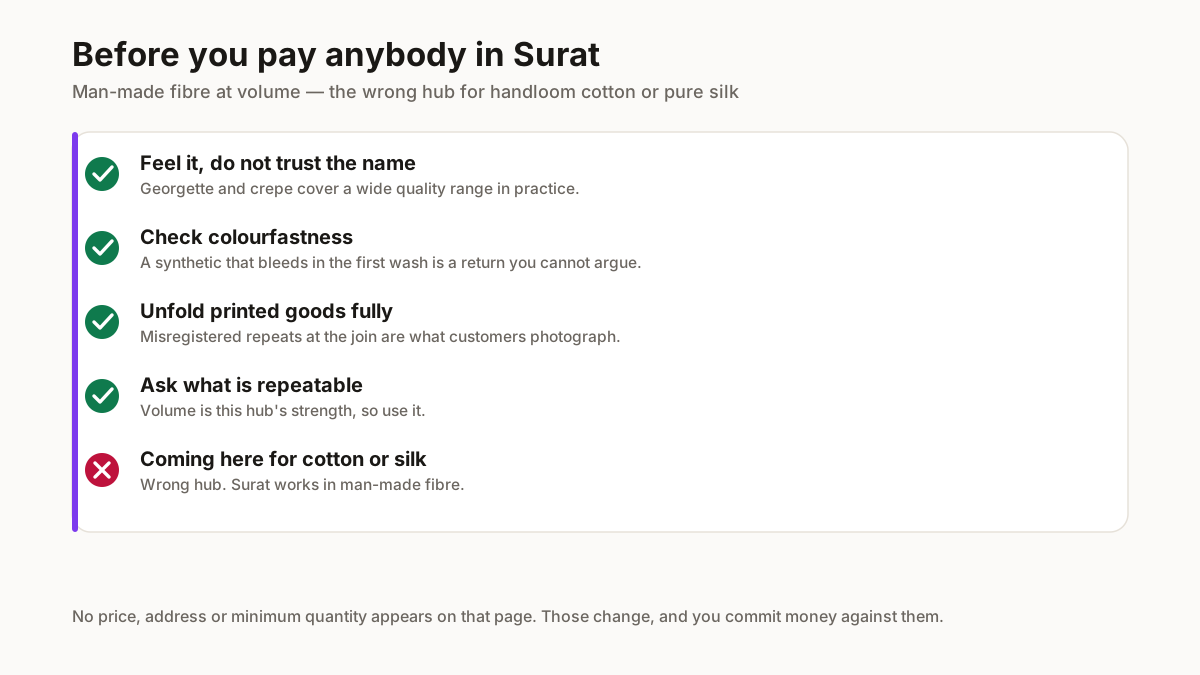
Wholesale here generally has no returns. Once you have paid, a defective piece is yours, which makes the checks below the only protection you get. Each takes under a minute.
Colourfastness
The one that generates returns weeks later. Ask directly whether the fabric has been tested, and on a bright synthetic assume it will bleed until told otherwise. A saree that runs in the first wash is a refund and a review you will not recover quickly.
Print registration on the repeat
Unfold a piece fully rather than judging from a folded sample. Where a pattern repeats, misalignment at the join is what a customer photographs and sends back, and it is invisible until the fabric is open.
The actual hand of the fabric
Georgette and crepe cover a wide quality range in practice, and two pieces sold under the same name can behave completely differently once worn. Hold it, hold it to the light, and watch how it falls rather than trusting the label.
Whether the design repeats next month
Surat's strength is that it can make more. A design you can reorder is worth more to a growing shop than a slightly cheaper one-off lot, because photographing something you will sell out of in a week is wasted work.
Take this checklist with you
Everything above is easy to remember at home and easy to forget in a crowded lane. Same list, printable, to carry in a bag.
Buying trip checklist — Surat
Print this and carry it. Tick as you go.
Before you leave
- ☐Confirmed the market is open today (call, do not assume)
- ☐Decided which market — they trade different goods
- ☐Cash split across two places, not one pocket
- ☐Notebook or phone notes ready — six suppliers blur into one
- ☐Someone with me, if this is the first trip
- ☐Plan for getting goods home before buying them
Which market for what
- ☐Ring Road markets — saree and dress material wholesale
- ☐Textile market cluster — printed polyester, georgette, chiffon
- ☐Processing houses — dyeing and printing, if you buy grey
Ask at every shop
- ☐What is the rate at the quantity I can actually take?
- ☐Will this design be available again next month?
- ☐What happens if a piece arrives defective?
- ☐What is the smallest lot you will sell me?
Check before paying
- ☐An inside seam — loose threads, skipped stitches, puckering
- ☐Colour across 3 or 4 pieces, in daylight not tube light
- ☐Which sizes are actually in the lot, counted not stated
- ☐Compared the rate against 2 other shops in the same lane
Wholesale generally has no returns. The checks above are the only protection you get.
What margin will this stock leave you?
Nobody can tell you what margin Surat gives you, and anybody who does is guessing. It depends on the piece, the channel and how well you bought. What is stable is which deductions apply where — and on synthetics that matters more than usual, because the price points are lower and a fixed per-order fee eats a bigger share of a cheaper saree.
Same garment, three channels
Put your own numbers in. Nothing here is assumed — commission is set by category and changes, so read yours from the channel’s rate card. The return rates are starting points to overwrite with your own.
Return rate on each channel
Ad spend per order
Meesho
₹178
per order after returns · 25% margin
₹276 on a delivered order
commission + returns + ads
₹256
per order after returns · 37% margin
₹306 on a delivered order
no commission, ads to be found
WhatsAppMOST LEFT
₹300
per order after returns · 43% margin
₹321 on a delivered order
no commission, lowest returns
On these numbers the same piece leaves ₹123 more per order on WhatsApp than on the weakest channel — which is the argument for choosing the channel before choosing the stock. For the full picture including GST and a target margin, use the break-even calculator.
Why does listing the stock take longer than buying it?
The buying is a day or two. Photographing and listing is the fortnight, and synthetics are harder to photograph than most things.
Shiny fabric throws highlights that a phone camera turns into blown-out white patches, which makes an expensive-looking saree read as cheap on screen. Diffused daylight fixes it and costs nothing but a different time of day.
Then show the fall. Drape is most of what a saree buyer is judging and a flat-lay hides it entirely, so 1 photograph of how the fabric hangs beats 3 more angles of the same folded piece.
A lot of 40 sarees at 3 angles each is 120 images, every one of which has to meet a portal size before it can be uploaded. Budget 2 days for the shoot and 2 for the listings.
You have the stock. Now the listing.
After the trip
A drop of 40 sarees at 3 angles is 120 images to size
Every one has to meet a portal spec before it uploads, and shiny fabric is the hardest thing to shoot well. StitchMagic runs the whole drop through repair, four marketplace sizes and the WhatsApp catalogue in one pass.
- Repairs and sharpens the photo
- Exports the 4 marketplace sizes from one upload
- Keeps the primary image clean, so QC does not bounce it
- Renames every file to its SKU
- Builds the WhatsApp PDF catalogue
Is it actually free?
Single photos are free. No signup, no watermark, no daily limit.
Do my photos get uploaded?
No. It runs in your browser — the files never leave your phone.
Is it a subscription?
No. The bulk pack is a one-off ₹99, and one photo counts once.
Runs on the phone you carried through the Ring Road complexes. No laptop, and no upload.
Where does Surat stock get listed?
Meesho takes most of it, because printed sarees at everyday prices are exactly what that buyer is searching for and several categories need no GSTIN to start. Flipkart and Amazon both work and both want a GSTIN first.
WhatsApp is underrated for this category. A reseller forwarding 20 images of new arrivals to her own list sells synthetics well, and the images do the work without a marketplace commission coming out.
Whichever channel, the primary image rules bite hardest here: a shiny saree shot against a busy background fails Meesho QC as fast as one with a price sticker on it.
Why are there no prices on this page?
Because rates in Surat move with input costs, and man-made fibre tracks those more closely than cotton does. A per-metre or per-piece figure published here would be wrong within a quarter, and you would have committed money against it.
What does not change is what the city trades in and how buying works, which is what this page carries. If a guide quotes you a firm rate for a market it has never visited, treat that as a reason to doubt the rest of it.
Related free seller tools
Frequently Asked Questions
How many photos does a lot of 40 sarees need?
About 120 images if you shoot 3 angles each, and every 1 of them has to meet the portal size before upload. Budget 2 days for the shoot and 2 more for listings, or the stock sits unsold for weeks.
What is Surat known for in the textile trade?
Man-made fibre — synthetic sarees, dress material and printed fabric, produced at a scale no other Indian hub matches. It is the right market for georgette and printed polyester, and the wrong one for handloom cotton or pure silk.
Is Surat good for buying cotton sarees?
Generally no. Surat specialises in synthetics; cotton handloom trades more heavily elsewhere. Buying against a hub’s specialisation usually means paying more for less choice.
What is dress material?
An unstitched set sold as fabric rather than as a finished garment, usually 3 pieces: a kurta, a bottom and a dupatta. It is a different product to the customer than a stitched suit, and listings that blur the two produce returns.
No rate, minimum quantity or mill name appears here. Synthetic prices move with input costs, so ask directly and confirm before you buy depth.