What goes into a Blue Dart price?
Three inputs, where surface couriers have two. Zone and chargeable weight behave as they do everywhere; service level is the third, and it moves the number more than either.
Chargeable weight first, since it is the one you control. Every carrier bills on the greater of the scale reading and the volumetric figure — length × width × height in centimetres, divided by 5000, read as kilograms. On a premium rate the gap between those two figures costs more than it does on a surface rate, so a 500 grams garment shipped in a 1,200 grams box is expensive here in a way it is not elsewhere.
Blue Dart charge calculator
Couriers bill on chargeable weight — the greater of what the parcel weighs and what its size implies. Enter both and the calculator shows which one you are being billed on.
Actual weight
500 g
Volumetric weight
1200 g
Billed on
1200 g
This parcel is billed on its size, not its weight. Packing it smaller and flatter is the cheapest way to cut the bill — nothing about the goods has to change.
Blue Dart rate slabs are not loaded yet
The chargeable-weight figure above is correct and is the same for every courier in India. The rupee amount is not shown because we will not publish a rate we have not verified against a current rate card — you would price shipping against it. Check your own Blue Dart rate card, or work the margin out with the break-even calculator.
Pack tight before comparing quotes, not after. A parcel that drops a slab changes what the premium costs you.
Service level is where Blue Dart differs structurally. Domestic Priority, time-definite morning delivery and the surface products are separate offerings with separate rates, which is most of why published figures for “Blue Dart charges” disagree with each other — they are describing different products.
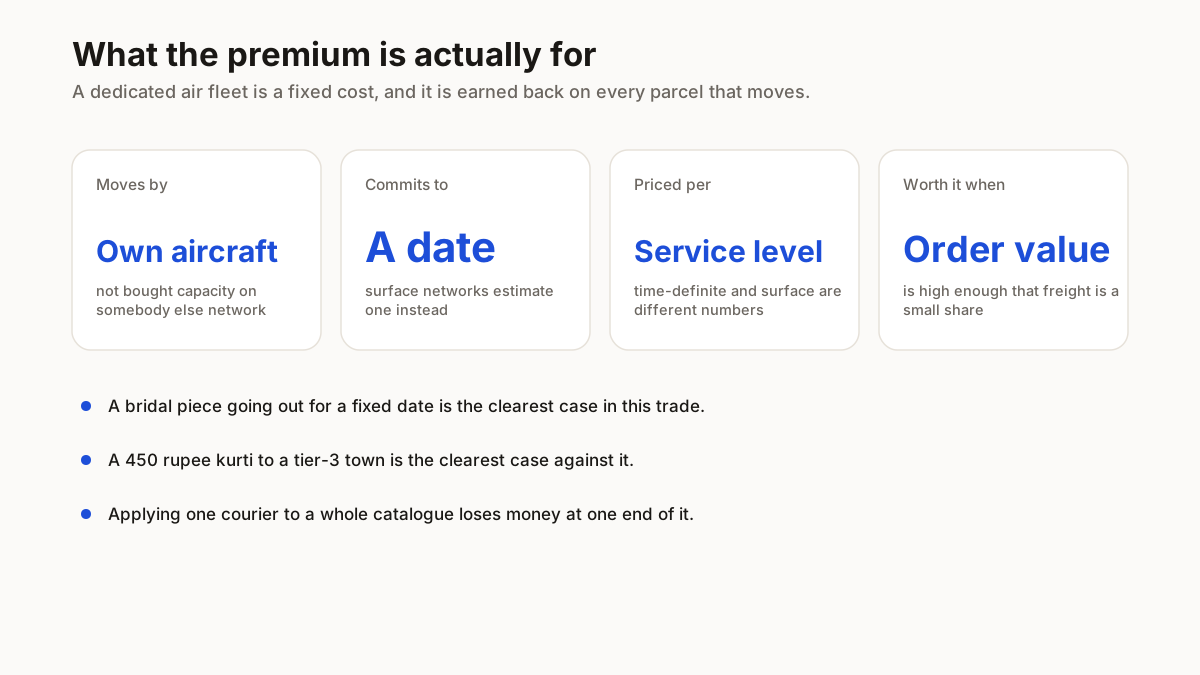
Underneath all of them sits a dedicated air fleet. Blue Dart moves a large share of its volume on its own aircraft instead of buying space on other people’s, and a fleet is a fixed cost earned back on every parcel. That is why the rate card starts higher and why the time commitments are firmer than a surface network can offer.
So the familiar complaint — Blue Dart costs more than DTDC — is true and slightly beside the point. It costs more the way an overnight service costs more than a two-day one. The question is whether your buyer is paying for the day saved.
Which orders justify paying a premium?
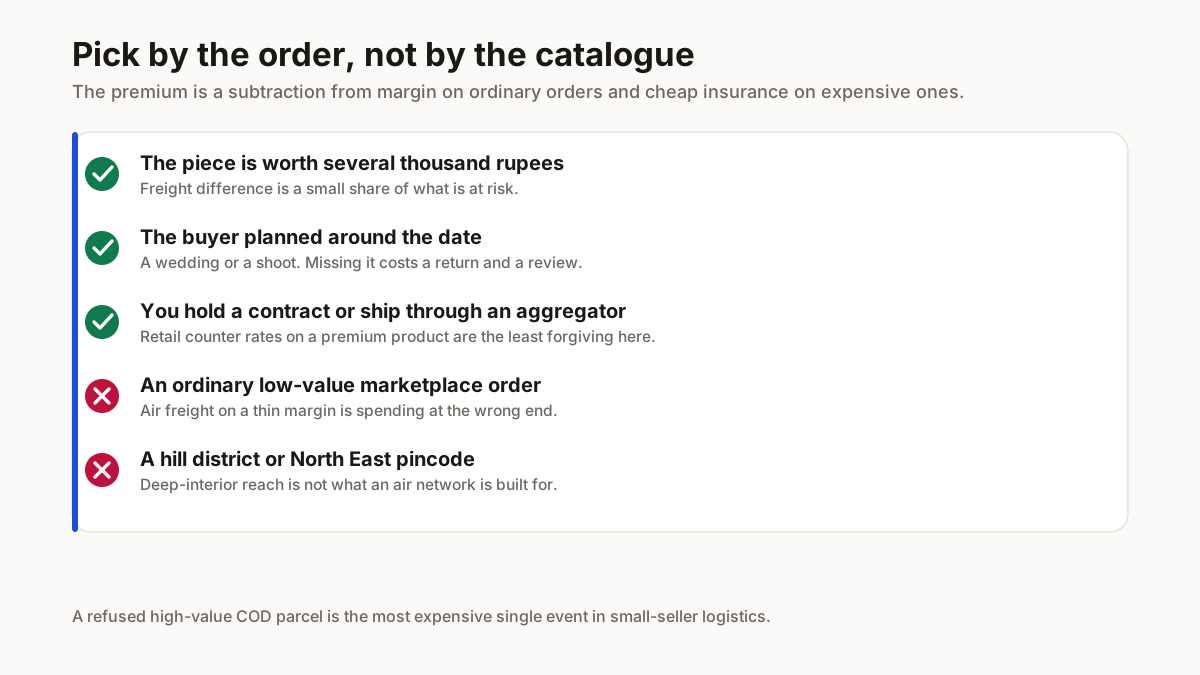
High-value goods make the clearest case. On a ₹6,000 piece the gap between premium and economy freight is a small fraction of the order and buys a materially better chance the parcel arrives intact and on time. A bridal lehenga going out for a fixed date is this argument in its purest form.
Date commitments make the second case. Promise a delivery date the buyer has planned around — a wedding, a shoot, a festival — and a service that commits to a date is worth more than one that estimates one. Missing that date costs a return, a refund and a review, which outrun a 40 rupee freight difference quickly.
Ordinary orders are where this goes wrong. A ₹450 kurti to a tier-3 town does not carry air freight; the premium comes straight out of a margin that was 60 rupees to begin with. Sellers who apply one courier across a whole catalogue lose money at one end of it or reputation at the other.
No contract is the other poor fit. Retail counter rates on a premium air product are the least forgiving pricing described anywhere on this site, and a small seller booking over the counter pays the maximum for a service she may not need.
How do you get a Blue Dart quote worth comparing?
Negotiate one, if you ship regularly. Blue Dart’s seller pricing is set against volume and lane mix, and the gap between contract and counter rates on a premium product is wide enough that a counter figure tells you very little about what you would pay.
Shipping through an aggregator gives you a second route: Blue Dart capacity often sits inside those platforms as one of the courier options, priced on the aggregator’s contract, not one you negotiated. Compare it there against the surface options for the same parcel. That comparison, on your own dashboard, is the only one about your costs.
Name the service level whenever you ask. A quote for time-definite morning delivery and a quote for the surface product are different numbers for one box, and the gap between them is the entire decision.
Blue Dart rate slabs
Not published here yet. Rate cards change and differ by contract, so a table assembled from memory would be wrong for most readers within a quarter. Read yours from your Blue Dart account or aggregator dashboard.
What sits outside the freight charge?
Fuel surcharge applies as a percentage of freight, and a percentage of a premium base is a larger absolute figure than the same percentage of a surface rate. It scales with every shipment.
Declared-value insurance matters more here than on the other carrier pages, for the obvious reason: you chose this service because the goods were worth protecting. Price it in; it is not optional paperwork here.
COD carries its own handling charge, and on expensive orders the percentage component dominates instead of the flat one — the reverse of how it behaves on cheap parcels. Worth asking whether COD suits an expensive piece at all. A refused ₹6,000 COD parcel is the costliest single event in small-seller logistics.
Out-of-delivery-area charges still apply, and deep-interior reach is not an air network’s strength; check the pincode before promising the date. Then cost the order end to end — the break-even price calculator handles goods, packing, freight, returns and commission together, and the prepaid vs COD calculator isolates the payment mode.
Photographs, listings, and the work before the parcel
After the trip
A premium courier cannot rescue a listing nobody clicked
Paying for guaranteed delivery on a piece that sells is sound. Paying for it on a piece whose photographs are dim and whose title reads like every other one is spending at the wrong end of the order.
- Repairs and sharpens the photo
- Exports the 4 marketplace sizes from one upload
- Keeps the primary image clean, so QC does not bounce it
- Renames every file to its SKU
- Builds the WhatsApp PDF catalogue
Is it actually free?
Single photos are free. No signup, no watermark, no daily limit.
Do my photos get uploaded?
No. It runs in your browser — the files never leave your phone.
Is it a subscription?
No. The bulk pack is a one-off ₹99, and one photo counts once.
Shoot the piece properly first. The courier decision gets easier when the margin is real.
Why no Blue Dart rate card here?
Because “the Blue Dart rate” is not one number even for one parcel. Service level splits it before contract and volume split it again, so a table here would have to pick a product and a customer and then present that choice as a fact about the carrier.
The premium products are also where a wrong published figure does the most damage. Underestimate a surface rate and an order earns less than expected. Underestimate a time-definite air rate and the order can go negative, which is a different kind of mistake.
What holds regardless of contract is on this page: the three inputs, what the fleet is paying for, and which orders carry the premium. Bring your own quote — with the service level named — to the calculator above.
Related free seller tools
Frequently Asked Questions
How is Blue Dart price calculated?
On chargeable weight, destination zone and service level. Chargeable weight is the greater of scale weight and volumetric weight (L × W × H in cm ÷ 5000, read as kg). Service level matters more here than with surface couriers, because time-definite and surface products carry separate rates for one box.
Why is Blue Dart more expensive than other couriers?
It runs a dedicated air fleet instead of buying capacity, and a fixed asset like that is earned back on every parcel. What you buy is speed and a firmer time commitment; on an ordinary low-value order that is a premium with nothing to show for it.
Is Blue Dart worth it for a small seller?
On high-value or date-critical orders, usually yes — the freight difference is small against the order value and against the cost of missing a promised date. On a ₹450 marketplace order, usually no. Applying one courier to a whole catalogue is what causes the problem.
Can I get Blue Dart rates without a contract?
You can book over the counter, but retail rates on a premium air product are the least forgiving pricing available. Regular shippers negotiate against volume, and many sellers reach Blue Dart capacity through an aggregator on the aggregator's contract instead.
Does Blue Dart deliver to all pincodes?
Not uniformly, and deep-interior reach is not what an air network is built for. Out-of-delivery-area charges apply where service is thin. Check the destination pincode before promising a delivery date, particularly for hill districts and the North East.
Blue Dart or Delhivery for a Meesho or Flipkart order?
On most marketplace orders the courier is assigned by the platform and the choice is not yours. Where it is yours, order value and urgency decide it, not the carrier name — the calculator above settles the weight slab, which you control either way.
No Blue Dart rate is printed here. Service level, contract and volume each move it, and a premium rate guessed wrong can take an order negative, not merely thin. Ask for a quote with the service named.