Footwear wholesalers: the two 2024 orders by material
Two Quality Control Orders cover footwear, both notified by DPIIT on 15 March 2024, effective 1 August 2024: Footwear made from All Rubber and All Polymeric Material and its Components; Footwear made from Leather and other Materials. Both replaced 2022 versions (BIS circular, 19 March 2024).
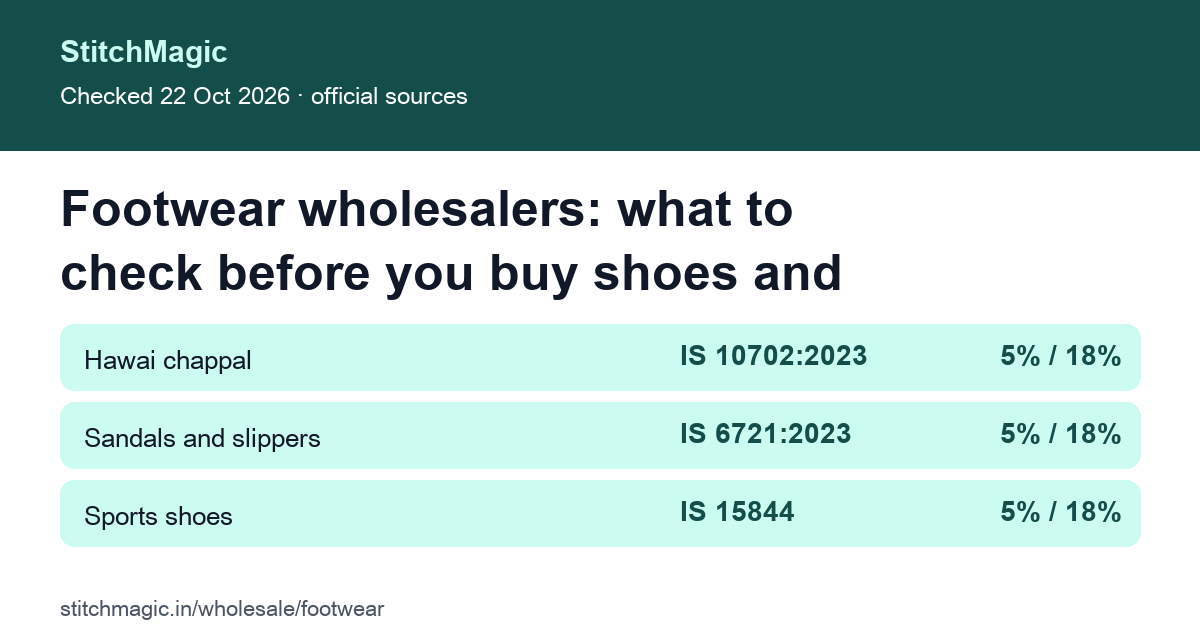
Chappals fall under rubber-polymeric rules: Hawai chappals (IS 10702:2023), sandals, slippers (IS 6721:2023), all-rubber gum boots, ankle boots (IS 5557), PVC industrial boots (IS 12254:2021), moulded plastics or PU boots (IS 16645:2018). Outsoles and sheets appear too, relevant if you buy components.
Leather-and-other-materials rules reach further than their name suggests. Rubber-soled canvas shoes (IS 3735:1996), canvas boots (IS 3736:1995), sports footwear for general, performance or professional use (IS 15844), general-purpose shoes (IS 17043): all sit beside leather safety boots. Canvas or sports sneakers therefore fall here despite containing no leather.
Wholesale shoes: which need the BIS (ISI) mark
Covered footwear "shall bear the Standard Mark under a license from the Bureau", meaning an ISI mark. Unmarked pairs from covered makers fail those orders, so inspect marks before discussing price (Gazette text attached to that BIS circular).
Both orders carry two exemptions: export goods, and "micro and small manufacturing units as defined in section 7 of the Micro, Small and Medium Enterprises Development Act, 2006". Hence an unmarked pair isn’t automatically illegal; it depends on its maker. Get your wholesaler to state, in writing, who made it and prove micro or small status.
Declared unmarked old stock had until 30 June 2025. Suppliers clearing "pre-2024 stock" now get no such cover.
Marked pair? Type its licence number into BIS CARE, whose field reads "Enter a valid licence no." Ask which IS number that licence covers; it should match what’s printed on your pair.
Chappal wholesale: checking a Hawai chappal or slipper lot
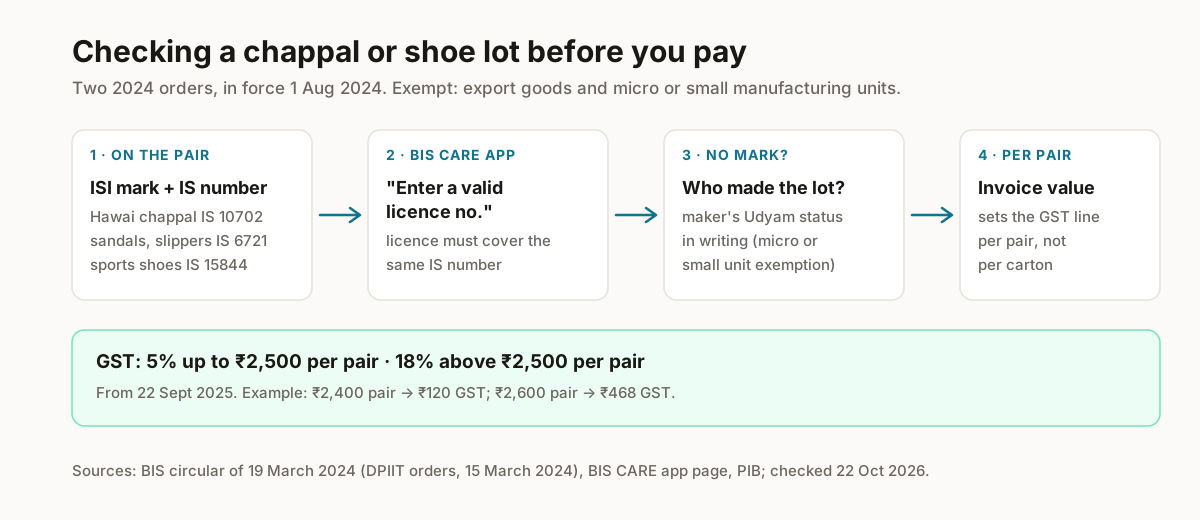
- Find ISI mark and IS number on pair or label. Hawai chappals: IS 10702. Sandals, slippers: IS 6721.
- Enter its licence number in BIS CARE. Ask which IS number it covers; it should match.
- No mark? Ask who made it. Get micro or small status in writing: for lots sold in India, such units are what both orders leave out.
- Note invoice value per pair. Per-pair value, not carton totals, decides 5% or 18%.
Wholesale shoes price list and GST per pair
Footwear GST is 5% when sale value stays within ₹2,500 per pair and 18% above, from 22 September 2025 (PIB). Schedule I S.No. 392 of Notification 9/2025-Central Tax (Rate) reads "Footwear of sale value not exceeding Rs.2500 per pair"; Schedule II S.No. 202–206 cover headings 6401 to 6405 at 18%.
We print no wholesale shoes price list: we hold no dated, sourced prices, and undated lists mislead. We give GST rules that apply to any quote instead. HSN lines by upper material: our shoes HSN code page.
Worked example (illustrative prices): two pairs either side of ₹2,500
One supplier invoices canvas sneakers at ₹2,400 per pair and sports shoes at ₹2,600 per pair. Sneakers sit in 5%: ₹120 GST per pair. Sports shoes cross ₹2,500, so 18%: ₹468 per pair. Same invoice, two lines, two rates; billing both at 5% puts line two wrong.
First copy shoes wholesale: why marketplaces reject them
Meesho lists counterfeit goods, "unauthorised replicas or fake imitations of real products", as prohibited, and says it will delist sellers who list them (Meesho Supplier learning hub, retrieved 4 Oct 2026). If a "first copy" pair imitates a real brand’s product, it is exactly such an item, so skip it for Meesho.
Wholesale shoes online or from a market
Channel changes nothing. On B2B apps, request photos of ISI mark, licence number and per-pair price before ordering; in city markets, inspect pairs yourself. Our guide to online wholesale websites explains ordering there; our wholesale hub covers other categories.
Listing footwear on Meesho?
ListMagic creates your Meesho listing for each product: title, category, attributes, images and price, so a pair of chappals and a pair of sports shoes each go up as a listing of their own. Free plan to start; Seller Pass ₹99 a month (StitchMagic pricing, checked 16 Oct 2026).
Try ListMagicFootwear supplier list
We are building a list of footwear wholesalers who sell to small resellers and can show the BIS licence for the pairs they sell. Every number on it comes from a supplier who asked to be listed.
Your number is used to send the list and nothing else.
Footwear wholesale questions
What should I check with footwear wholesalers before buying?
Check ISI mark and licence number for that footwear type, who made it, and invoice value per pair. Per-pair value sets GST at 5% or 18%.
Do sports shoes bought wholesale need the BIS mark?
Yes, sports footwear is under IS 15844 in the 2024 leather and other materials order, unless made by a micro or small unit.
Is there a wholesale shoes price list?
Not one we can date or source, so we print the GST band per pair instead: 5% up to ₹2,500, 18% above.
Is chappal wholesale covered by BIS?
Yes, Hawai chappals (IS 10702) and sandals and slippers (IS 6721) are in the rubber and polymeric order, in force since 1 August 2024.
Can I buy first copy shoes wholesale and sell them online?
Not on Meesho if the pair imitates a real brand: Meesho prohibits counterfeit goods and says it will delist sellers who list them.
Can I buy wholesale shoes online?
Yes, with identical mark and per-pair GST checks. Request photos of mark and licence number before ordering.
Related
Checked by the StitchMagic team on 22 Oct 2026. StitchMagic is a set of free tools and one AI listing agent (ListMagic) for online sellers in India that helps them list faster on Meesho, Flipkart and Amazon.in and sell more. Found an error? Tell us; we correct with a dated note.